Kettlebell Workout for Beginners: 10 Exercises and a 6-Week Plan
A kettlebell is a cast-iron ball with a handle, and that odd shape is the whole point. Because the weight sits below your hand rather than on either side of it, a kettlebell can be swung, hugged to your chest, pressed and carried in ways a dumbbell cannot. One bell and a couple of square metres of floor are enough for a full-body strength and conditioning session.
It is also a tool people tend to rush. The kettlebell swing looks simple and is easy to do badly, usually by squatting it and lifting with the arms, which is how beginners end up with a sore lower back. The fix is to learn the movements in the right order: the hip hinge first, the deadlift second, and only then the swing.
This guide follows that order. It covers what weight to buy, how to hold the bell, ten exercises in the sequence you should learn them, a step-by-step method for the swing, and a six-week plan that needs just one kettlebell.
At a glance
- Most women start well with 8 to 12 kg, most men with 12 to 16 kg
- Learn the hip hinge and the kettlebell deadlift before you try the swing
- The swing is a hip movement. Your arms guide the bell, they do not lift it
- One kettlebell covers squats, hinges, presses, rows and carries
- Two to three sessions a week of 20 to 30 minutes is plenty
- Train on a clear floor, and never let a bell swing toward your shins or feet
What makes kettlebells different
| Feature | Kettlebell | Dumbbell |
|---|---|---|
| Weight position | Hangs below the handle | Balanced on both sides of the hand |
| Best at | Swings, carries, goblet squats, flowing movements | Curls, presses, rows, isolation work |
| Grip demand | High, the handle is thick and the load shifts | Moderate |
| Learning curve | Steeper for swings and cleans | Gentle |
| Conditioning | Excellent, swings raise the heart rate quickly | Good |
| Space needed | Small, but you need clear swing room | Small |
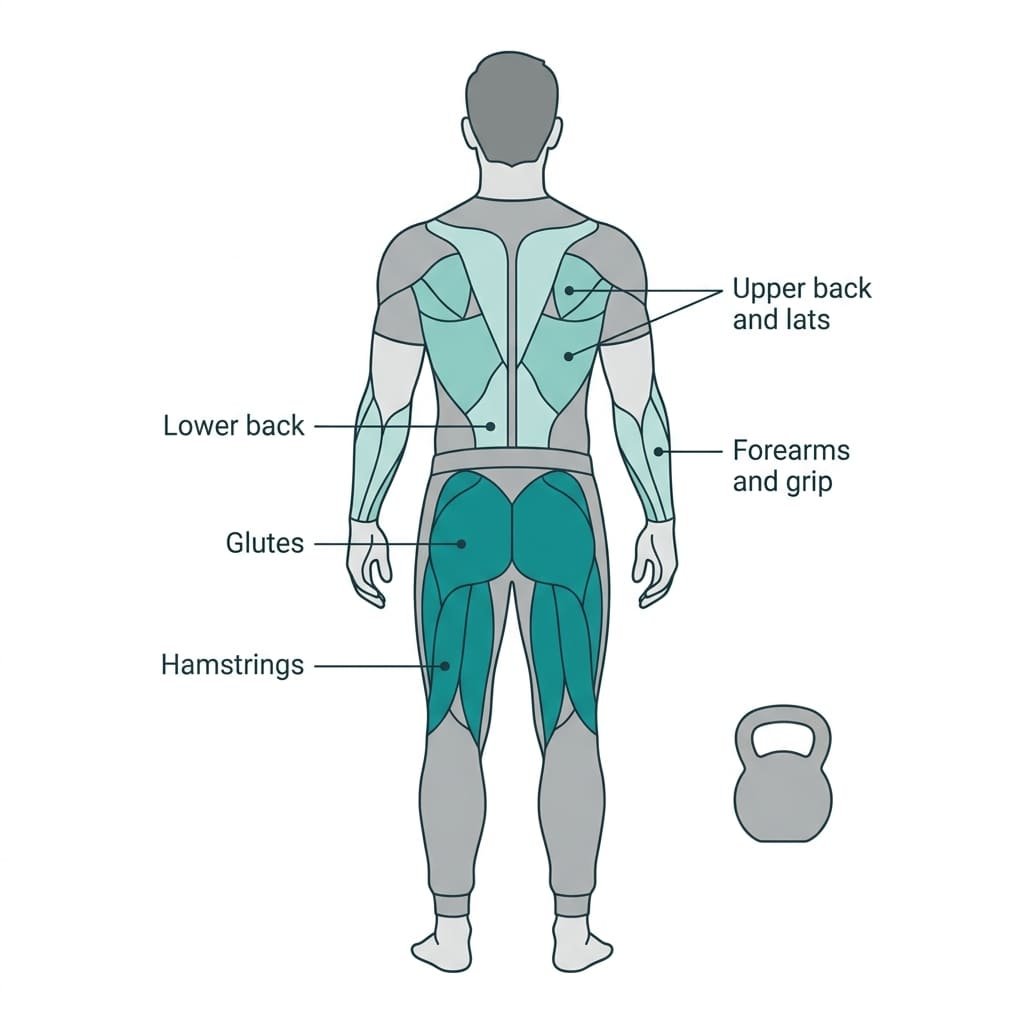
The offset weight makes kettlebells particularly good for training the hip hinge, the movement behind picking things up from the floor. Swings, deadlifts and carries train your glutes, hamstrings, back and grip together, and they do it at a pace that also challenges your heart and lungs.
Neither tool is better. If you already own dumbbells, a single kettlebell adds swings and goblet squats. If you own nothing, one kettlebell is one of the most complete pieces of equipment you can buy.
What weight kettlebell should a beginner buy?
Kettlebells are sold in kilograms, usually in 4 kg steps. Buy one bell to start.
| You are | Starting weight | In pounds |
|---|---|---|
| A woman new to strength training | 8 kg | About 18 lb |
| A woman with some training experience | 12 kg | About 26 lb |
| A man new to strength training | 12 kg | About 26 lb |
| A man with some training experience | 16 kg | About 35 lb |
| Older, returning from injury, or unsure | One size lighter than above |
How to check you chose well: you should be able to deadlift the bell for 10 easy reps, hold it at your chest for a goblet squat for 8 to 10 reps, and press it overhead with one arm 5 times with good control. If you cannot press it at all, that is fine at first, since your legs and hips will always be stronger than your shoulders.
One bell is a compromise. A weight that suits swings and deadlifts will feel heavy for presses, and a weight that suits presses will feel light for swings. That is normal. Most people add a second, heavier bell after a few months and keep the lighter one for upper body work.
A 30 lb kettlebell, close to 14 kg, sits between the standard 12 and 16 kg sizes and is a reasonable single bell for many men and for stronger women.
Choose a bell with a smooth, single-piece cast handle wide enough for both hands. Cheap bells with a seam along the handle or a plastic coating that slips make swings uncomfortable and less safe.
How to hold a kettlebell
| Grip | How | Used for |
|---|---|---|
| Two-hand handle grip | Both hands on the handle, bell hanging down | Deadlifts, swings |
| By the horns | Hands on the sides of the handle, bell upright or upside down at the chest | Goblet squats, halos |
| Rack position | Bell resting on the back of the forearm against the chest, wrist straight, elbow tucked | Presses, front squats, lunges |
| Suitcase grip | One hand on the handle, arm by your side | Carries, single-arm deadlifts |
The rack position takes practice. The handle should sit diagonally across the palm, low toward the heel of the hand, so the wrist stays straight and the bell rests on the forearm. If the wrist bends back, the bell will feel heavy and uncomfortable.
Learn the hip hinge first
Every important kettlebell movement is built on the hip hinge. Spend a session or two on it before you add speed.
- Stand with your feet hip to shoulder width apart
- Soften your knees slightly and keep them there
- Push your hips straight back, as if closing a car door with your backside
- Let your chest tip forward as your hips go back, keeping your back flat
- Stop when you feel your hamstrings stretch, then squeeze your glutes to stand up tall
The test: hold a broomstick along your back so it touches your head, upper back and tailbone. Hinge without losing any of the three contact points. If you can, your hinge is clean.
A squat sends the knees forward and the hips down. A hinge sends the hips back and keeps the shins almost vertical. The swing is a hinge. Our good morning exercise guide is a useful way to drill the same pattern.
10 kettlebell exercises for beginners
Learn them in this order. Each one prepares you for the next.
1. Kettlebell deadlift
Stand over the bell with it between your ankles. Hinge down, grip the handle with both hands, flatten your back and stand up by driving your hips forward. Lower it by hinging again.
- Reps: 3 sets of 10
- This is the swing in slow motion. Master it first
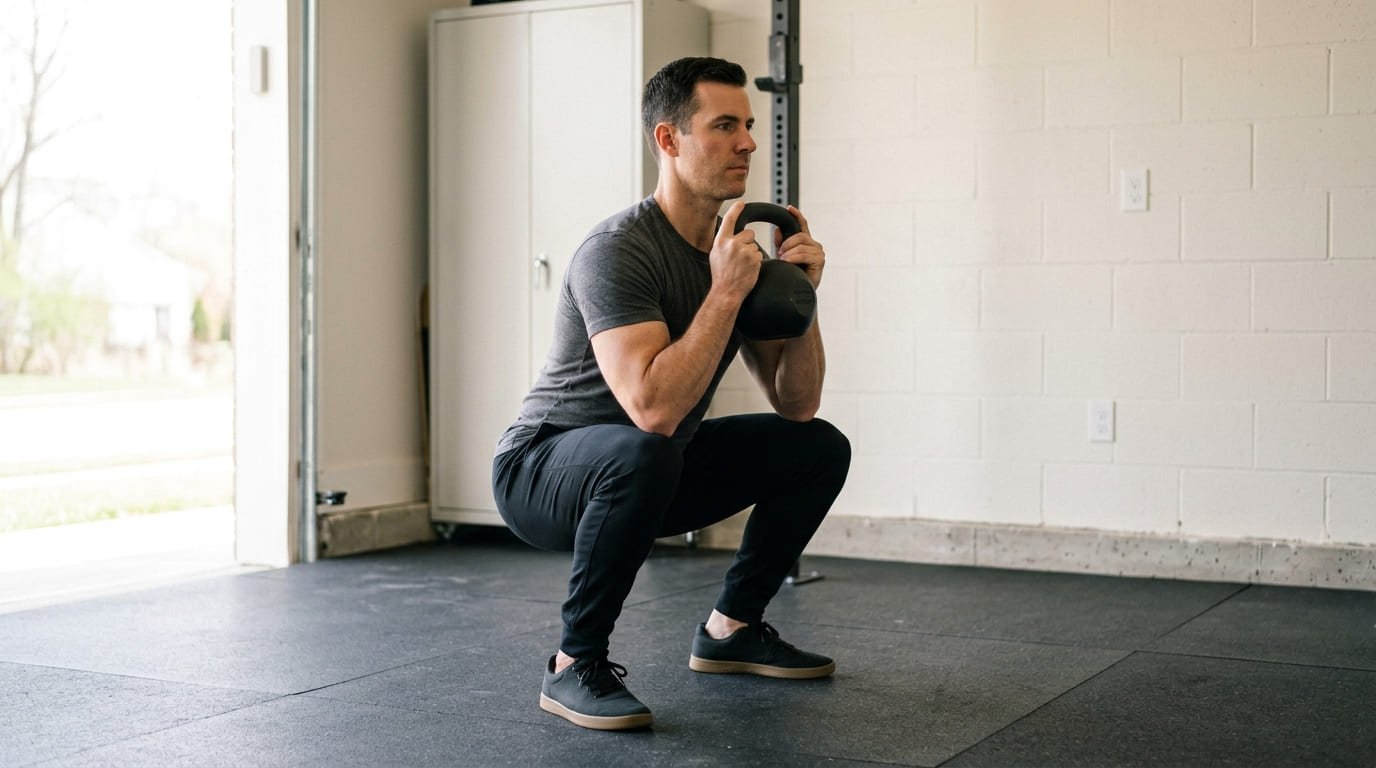
2. Goblet squat
Hold the bell by the horns against your chest. Squat down between your knees with your chest tall, then stand.
- Reps: 3 sets of 8 to 10
- The bell acts as a counterweight, which makes it easier to squat deep with good posture
3. Halo
Hold the bell upside down by the horns at chest height and circle it slowly around your head, keeping your ribs down and your body still.
- Reps: 2 sets of 6 circles each direction
- A good warm-up for the shoulders and upper back
4. Suitcase carry
Hold the bell in one hand at your side and walk, standing tall and refusing to lean toward the weight.
- Distance or time: 3 carries of 20 to 30 metres per side
- Our farmer’s carry guide covers carries in more detail
5. Single-arm row
Hinge forward with one hand on a chair for support and row the bell toward your hip with the other.
- Reps: 3 sets of 8 to 10 per side
6. Kettlebell swing
The signature exercise. See the next section for the full method.
- Reps: 5 sets of 10, resting 45 to 60 seconds
7. Overhead press
From the rack position, brace your body and press the bell straight overhead until your arm is locked out, then lower it under control to the rack.
- Reps: 3 sets of 5 to 8 per side
- Squeeze your glutes and keep your ribs down so you do not lean back
8. Reverse lunge, goblet hold
Hold the bell at your chest and step back into a lunge, lowering the back knee toward the floor, then return.
- Reps: 3 sets of 6 to 8 per leg
9. Single-leg deadlift, with support
Hold the bell in one hand and a wall or chair with the other. Hinge on the opposite leg, letting the free leg extend behind you.
- Reps: 3 sets of 6 to 8 per side
10. Russian twist or seated rotation
Sit with your knees bent, lean back slightly with a straight back, and rotate the bell from hip to hip.
- Reps: 2 sets of 10 per side
- Use a light bell and move with control
Once these feel comfortable, the windmill exercise is a good next skill.
How to do the kettlebell swing
The swing is a fast hip hinge. Your hips throw the bell forward and your arms simply connect you to it.
- Set up with the bell about a foot in front of you on the floor
- Hinge down and grip the handle with both hands, tilting the bell toward you. Your back is flat and your shoulders are above your hips
- Hike the bell back between your legs, like a rugby or American football snap, keeping it high and close to your groin
- Stand up fast by snapping your hips forward and squeezing your glutes hard. The bell floats up from that hip drive
- Let the bell rise to about chest height. Your arms stay loose and long, and you should be standing tall with a straight line from ankles to shoulders
- Let it fall and hinge at the last moment, guiding it back between your legs
- To finish, let it swing back, then park it on the floor in front of you
| Mistake | What it looks like | Fix |
|---|---|---|
| Squatting the swing | Knees bend deeply, the bell travels down toward the floor | Push the hips back, shins stay near vertical |
| Lifting with the arms | Shoulders tire first, the bell is muscled up | Arms loose, power from the hip snap |
| Leaning back at the top | Lower back arches | Finish tall, glutes tight, ribs down |
| Bell too low on the backswing | It drops toward the knees | Keep it high, forearms touching the inner thighs |
| Rounding the back | Spine curves on the backswing | Flat back, chest proud, lighter bell |
| Going overhead | The bell passes head height | Stop at chest height for now |
Learn it in three steps: first the deadlift, then the hike pass (hike the bell back and return it to the floor without standing), then the full swing in sets of five.
Breathe out sharply at the top of each swing as your hips snap forward. It helps you brace and sets the rhythm.
The beginner kettlebell workout
Do this two or three times a week with at least a day between sessions. It takes about 25 minutes.
Warm-up, 4 minutes: 10 bodyweight squats, 10 hip hinges, 6 halos each way, 10 arm circles each way, and 10 easy deadlifts.
| Exercise | Sets | Reps | Rest |
|---|---|---|---|
| Kettlebell deadlift | 3 | 10 | 45 sec |
| Goblet squat | 3 | 8 to 10 | 60 sec |
| Single-arm row | 3 | 8 per side | 45 sec |
| Overhead press | 3 | 5 to 8 per side | 60 sec |
| Kettlebell swing | 4 | 10 | 45 sec |
| Suitcase carry | 2 | 20 metres per side | 45 sec |
If you have not learned the swing yet, do a fourth set of deadlifts in its place for the first two weeks.
A 6-week plan
| Weeks | Focus | What to do |
|---|---|---|
| Weeks 1 to 2 | Learn the patterns | Deadlift, goblet squat, row, halo, suitcase carry. Practise the hip hinge and hike pass. No swings yet, or sets of 5 only |
| Weeks 3 to 4 | Add the swing and the press | Full workout above. Swings in 4 sets of 10 |
| Weeks 5 to 6 | Build volume | Add a set to squats, rows and presses. Swings in 6 sets of 10, or 10 swings at the start of each minute for 6 minutes |
After six weeks, progress by adding reps, adding sets, reducing rest, or buying a heavier bell for the lower body movements. Our sets and reps guide explains how to choose between those.
A 10-minute kettlebell session for busy days
On days when 25 minutes is not available, this covers the essentials. Set a timer for 10 minutes and work through the list, resting only as needed.
| Exercise | Reps |
|---|---|
| Goblet squat | 8 |
| Single-arm row | 6 per side |
| Kettlebell swing, or deadlift if you are still learning | 10 |
| Overhead press | 5 per side |
| Suitcase carry | 20 metres per side |
Repeat the list until the timer ends. Most beginners complete two to three rounds. It is not a replacement for the full workout, but two short sessions a week are far better than none.
What to do after the first six weeks
| If this is true | Do this next |
|---|---|
| You can swing your bell for 10 sets of 10 with good form | Buy the next size up for swings, deadlifts and squats |
| Presses are stuck at 3 to 5 reps | Keep the same bell and add one rep a week |
| Goblet squats feel easy at 12 reps | Slow the lowering to 3 seconds, or add a pause at the bottom |
| You want more variety | Learn the single-arm swing, then the clean, then the windmill |
| You want more conditioning | Try 10 swings at the start of every minute for 10 to 15 minutes |
Learn the clean before more advanced lifts. The clean is how you bring a kettlebell from the floor to the rack position in one smooth movement. It opens up front squats, presses and lunges with a heavier bell, and it is worth getting coaching or filming yourself to check the bell is not banging your forearm.
Kettlebells and weight loss
Kettlebell training is often marketed for fat loss, and it does help, with a realistic caveat.
- Swings and circuits raise your heart rate and burn a useful number of calories in a short session
- The strength work helps you keep muscle while you lose weight, which matters for how you look and feel
- It is time-efficient, combining strength and conditioning in 20 to 30 minutes
But no exercise tool causes fat loss on its own. That comes from eating slightly less than you burn over weeks and months. Kettlebells make a good training half of that equation. A simple fat-loss session is 10 swings and 5 goblet squats at the start of every minute for 10 to 15 minutes.
Use our calorie calculator to set a sensible intake to go with it.
Safety checklist
- Clear the floor in front of and behind you. A swinging bell needs space
- Train on a surface you do not mind dropping a bell on, and never try to catch a bell that is getting away from you. Let it go and step back
- Wear flat shoes or go barefoot. Cushioned running shoes make you less stable
- Keep your back flat on every hinge, deadlift and swing
- Dry your hands. A sweaty handle slips
- Stop a set when your form changes, not when you cannot lift the bell
Talk to a doctor first if you have a current back injury, uncontrolled high blood pressure, a hernia or you are pregnant. Swings in particular place fast, repeated load on the back and trunk.
Seven beginner mistakes
- Starting with the swing before learning the hinge and the deadlift
- Buying a bell that is too light, so the legs and hips never get challenged
- Buying one that is too heavy and never being able to press it with control
- Squatting the swing instead of hinging
- Letting the wrist bend back in the rack position
- Rushing through reps instead of owning each position
- Training every day. Two or three sessions a week leaves room to recover
The bottom line
A single kettlebell is enough for a complete beginner programme. It trains your legs, hips, back, shoulders, grip and conditioning in sessions of 20 to 30 minutes.
Buy one bell: 8 to 12 kg for most women, 12 to 16 kg for most men. Learn the hip hinge and the deadlift before you swing. When you do swing, drive it with your hips and keep your arms relaxed.
Follow the six-week plan two or three times a week, keep your back flat and your floor clear, and add weight only when the movements feel smooth.
For a step-by-step breakdown of the most important kettlebell exercise, see our kettlebell swing guide. For core work with the same bell, try our kettlebell ab workout.
Frequently asked questions
What weight kettlebell should a beginner use?
Most women start well with 8 to 12 kg and most men with 12 to 16 kg. You should be able to deadlift the bell for 10 easy reps and goblet squat it for 8 to 10. If you are older, returning from injury or unsure, choose one size lighter.
What are the best kettlebell exercises for beginners?
The kettlebell deadlift, goblet squat, single-arm row, halo, suitcase carry, overhead press and, once the hip hinge is solid, the two-hand swing. Together they cover squatting, hinging, pushing, pulling and carrying with a single bell.
How often should a beginner do kettlebell workouts?
Two to three times a week, with at least one rest day between sessions. Each session can be 20 to 30 minutes. That is enough to build strength and conditioning while giving your grip, back and shoulders time to recover.
Are kettlebell swings safe for beginners?
Yes, if you learn the hip hinge and kettlebell deadlift first. Most problems come from squatting the swing, lifting with the arms or rounding the back. Start with a manageable weight, keep the bell at chest height, and stop the set when your form changes.
Can you lose weight with kettlebell training?
Kettlebell circuits and swings burn a useful number of calories and help you keep muscle while losing weight, but fat loss depends on eating slightly less than you burn. Kettlebell training works well as the exercise half of a weight loss plan.
Is one kettlebell enough for a full-body workout?
Yes. One bell covers squats, deadlifts, swings, rows, presses, lunges and carries. The compromise is that a weight suited to swings will feel heavy for presses, so many people add a second, heavier bell after a few months.
Are kettlebells better than dumbbells?
Neither is better overall. Kettlebells are superior for swings, carries and goblet squats and give a strong conditioning effect. Dumbbells are easier to learn and better for curls, presses and isolation work. Many home trainers use both.
How long does it take to see results from kettlebell training?
Most beginners feel stronger and fitter within three to four weeks of training two or three times a week. Visible changes in muscle and body composition usually take eight to twelve weeks and depend heavily on your eating and overall activity.
What’s next?
Reading is the easy part. Pick one of these and do it today.