
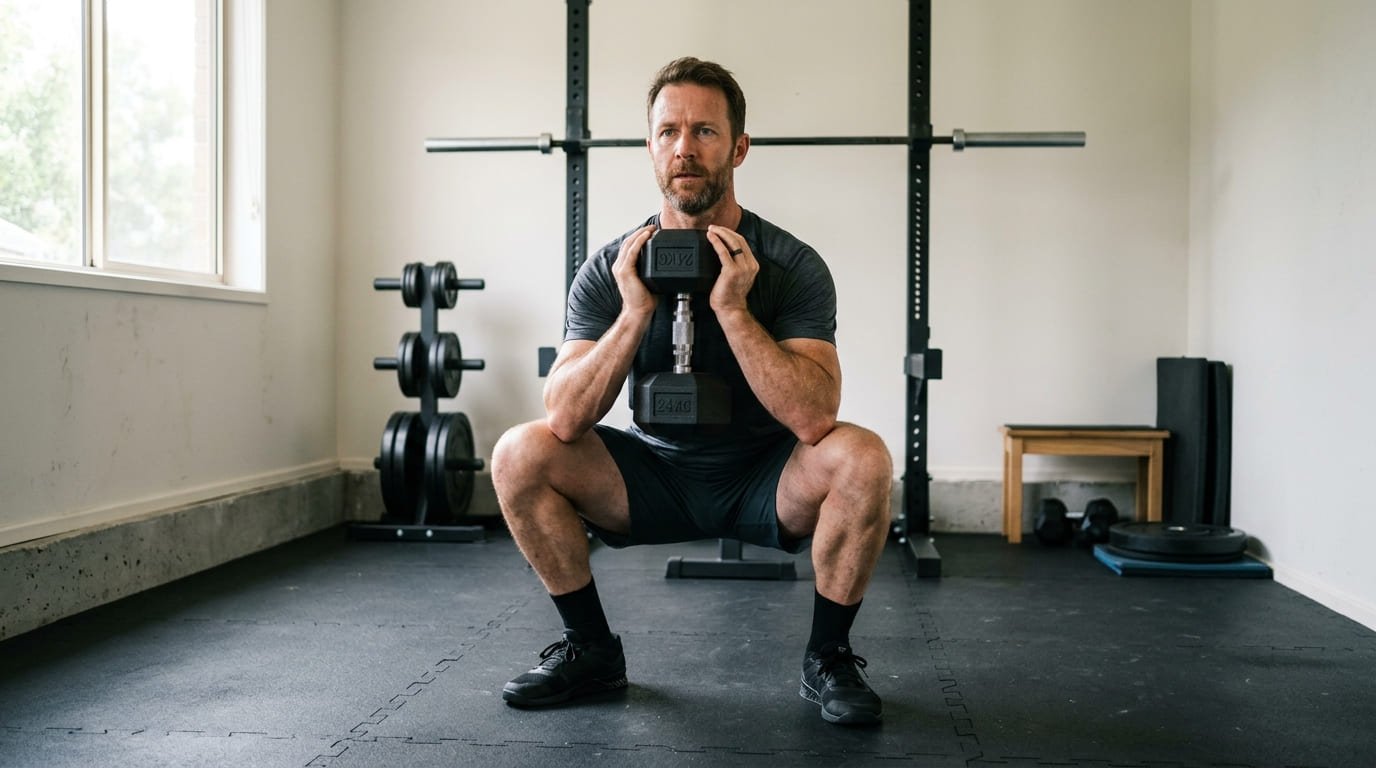
The 2-2-2 Workout Method: A Complete Guide and 8-Week Plan
The 2-2-2 workout method has spread quickly, particularly among people over 40 and anyone with a schedule that will not tolerate five gym sessions a week. The appeal is obvious: it is easy to remember, it asks for very little time, and the claim is that you can still build muscle and strength on it.
The name refers to three numbers: two full-body sessions a week, two working sets per exercise, and two reps left in reserve on every set.
I want to do two things in this guide. First, explain exactly what the method prescribes and give you a complete plan you can follow, including both sessions, the progression rules and how to warm up. Second, be honest about where it works well and where it falls short, because the coverage of this method is unusually uncritical and there are real trade-offs worth knowing before you commit eight weeks to it.
At a glance
- Two full-body sessions a week, two hard working sets per exercise, two reps in reserve
- Sessions run 35 to 50 minutes, covering squat, hinge, push and pull patterns
- The low volume is the point: it is designed around recovery and joint tolerance
- It works genuinely well for beginners, returners, busy people and those over 40
- It is not ideal if your goal is maximum muscle growth, since total weekly volume is low
- A complete 8-week plan with both sessions and progression rules is below
What the 2-2-2 method actually is
Each number refers to a different variable, which is why the name is easy to remember and easy to misunderstand.
| The number | What it refers to | Why |
|---|---|---|
| First 2 | Two full-body workouts per week | Each muscle group gets trained twice weekly, which is enough for growth |
| Second 2 | Two hard working sets per exercise | Keeps session length down and total fatigue low |
| Third 2 | Two reps in reserve on every set | Stops short of failure, which speeds recovery and protects joints |
The structure of each session covers four fundamental movement patterns, plus a couple of accessories:
- Squat pattern: squats, leg press, split squats
- Hinge pattern: Romanian deadlifts, hip thrusts, good mornings
- Push pattern: bench press, overhead press, push-ups
- Pull pattern: rows, pulldowns, pull-ups
- One or two accessories: lateral raises, curls, calf raises, core work
Two sessions a week, spaced two to three days apart, four to six exercises each, two working sets per exercise. That comes to roughly 16 to 24 working sets per week in total.
What “two reps in reserve” actually means
This is the part most people get wrong, and it is the part that decides whether the method works at all.
Reps in reserve, or RIR, is how many more reps you could have completed at the end of a set. Two reps in reserve means you stopped when you could have done exactly two more with good form.
| How the set felt | Reps in reserve | Right for this method? |
|---|---|---|
| Could have done 5 or more | 5 or more | No, far too easy to drive adaptation |
| Could have done 3 or 4 | 3 to 4 | Slightly too easy |
| Could have done 2 | 2 | Correct |
| Could have done 1 | 1 | Acceptable occasionally |
| Could not do another | 0 | Too hard for this method’s recovery model |
The hard truth about low-volume training is that the intensity has to be real. With only two sets per exercise, there is no room for junk volume. A set taken to 5 RIR in a 20-set weekly programme still contributes something. A set taken to 5 RIR when you only have two of them is close to wasted.
Most beginners significantly overestimate how close they are to failure. A useful calibration exercise: once a fortnight, take your final set of one exercise all the way to genuine failure and count how many reps you got past your normal stopping point. If it was five, your sets have been far too easy.
Does it actually work? An honest assessment
Here is what the research supports and what it does not.
Twice-weekly frequency is well supported. Training each muscle group twice a week produces better growth than once a week at equal total volume, which is the strongest evidence-based element of this method.
Stopping short of failure is well supported. Training to absolute failure on every set adds substantial fatigue without proportionally more growth. Leaving one to three reps in reserve produces comparable results with far better recovery.
Two sets per exercise is the debatable part. Research on training volume generally shows a dose-response relationship: more weekly sets per muscle group produce more growth, up to a point, with roughly 10 or more sets per muscle group per week associated with better hypertrophy outcomes than lower volumes.
On the 2-2-2 method, a muscle group like the chest gets around four direct sets a week, plus some indirect work. That is below the volume associated with maximum growth in the research.
So the honest summary is this:
- For strength, it works well. Strength responds strongly to intensity and practice frequency, both of which this method delivers
- For beginners, it works very well. Low volumes produce excellent results when you are new, and the simplicity aids consistency
- For general fitness and health, it comfortably meets the recommendation of two strength sessions a week
- For maximum muscle growth in a trained lifter, it is below optimal, and you should expect slower progress than a higher-volume programme
- Compared to not training at all, which is the real alternative for most people considering it, it is dramatically better
That last point matters more than the volume debate. A programme you do twice a week for a year beats an optimal programme you abandon in three weeks.
Who this method suits
| This suits you well if | This may not suit you if |
|---|---|
| You have limited time, two sessions is realistic | You have time for 4 or more sessions and want maximum growth |
| You are over 40 and joints need more recovery | You are an experienced lifter chasing hypertrophy |
| You are returning after a break | You are preparing for a physique competition |
| You are a complete beginner | You enjoy longer, more varied sessions |
| You have a physically demanding job | You want to specialise in one body part |
| You keep starting programmes and abandoning them | You are already progressing well on higher volume |
The over-40 framing this method usually gets is fair but slightly overstated. Recovery capacity does decline gradually with age, and joint tolerance for high-volume, high-frequency work often decreases. But the method is not age-specific. It is volume-specific, and it suits anyone whose recovery, schedule or motivation is the binding constraint.
The warm-up, which the method usually omits
Almost every write-up of this method leaves out the warm-up, which matters more here than usual because you only have two working sets and the first one needs to count.
- Five minutes of easy cardio: walking, cycling or rowing
- Dynamic mobility: 10 leg swings each way, 10 arm circles, 8 hip circles, 8 cat cows
- Two ramp-up sets on your first exercise: one at roughly 50 percent of your working weight for 8 reps, one at 75 percent for 4 reps
- One ramp-up set on each subsequent compound exercise
Ramp-up sets do not count toward your two working sets. This trips people up: two working sets means two hard sets, not two sets in total.
The complete 8-week plan
Two sessions, performed with two to three days between them. Monday and Thursday, or Tuesday and Friday, work well.
Workout A
| Exercise | Pattern | Sets | Reps | Rest |
|---|---|---|---|---|
| Goblet or back squat | Squat | 2 | 6 to 10 | 2 to 3 min |
| Romanian deadlift | Hinge | 2 | 8 to 12 | 2 to 3 min |
| Bench press or push-up | Push | 2 | 6 to 10 | 2 min |
| One-arm dumbbell row | Pull | 2 | 8 to 12 | 2 min |
| Lateral raise | Accessory | 2 | 12 to 15 | 60 sec |
| Plank or dead bug | Core | 2 | 30 to 45 sec | 60 sec |
Workout B
| Exercise | Pattern | Sets | Reps | Rest |
|---|---|---|---|---|
| Bulgarian split squat | Squat | 2 | 8 to 12 each leg | 2 min |
| Hip thrust or glute bridge | Hinge | 2 | 10 to 15 | 2 min |
| Overhead press | Push | 2 | 8 to 12 | 2 min |
| Lat pulldown or assisted pull-up | Pull | 2 | 8 to 12 | 2 min |
| Dumbbell curl | Accessory | 2 | 10 to 12 | 60 sec |
| Calf raise | Accessory | 2 | 15 to 20 | 45 sec |
At home with dumbbells only, swap the back squat for goblet squats, the bench press for floor press or push-ups, the lat pulldown for a band pulldown or inverted row, and the hip thrust for a dumbbell glute bridge. Our beginner dumbbell workout plan covers these substitutions in more detail.
The progression rules
This is what makes the plan work, and it is where most write-ups stop short.
Use double progression:
- Start at the bottom of the rep range with a weight you can handle at 2 RIR
- Each session, try to add one rep to each set while keeping 2 RIR honest
- When you hit the top of the range on both sets, add weight next session: 2.5 kg for upper body, 5 kg for lower body
- Drop back to the bottom of the rep range at the new weight and repeat
- If you stall for three sessions, reduce the weight by 10 percent and build back up
| Weeks | What to expect | What to do |
|---|---|---|
| Weeks 1 to 2 | Learning the exercises, calibrating 2 RIR | Focus on technique, expect to underestimate effort |
| Weeks 3 to 4 | Steady rep additions most sessions | Keep adding reps, start adding weight |
| Weeks 5 to 6 | Progress slows on upper body first | Smaller weight jumps, 1.25 kg if possible |
| Weeks 7 to 8 | Progress mostly on lower body | Consider a lighter week if fatigue accumulates |
Write everything down. With only two sets per exercise, you cannot afford to guess what you did last week. The log is not optional on a low-volume programme, it is the mechanism that makes it work.
How to adapt it if progress stalls
Since the method’s weak point is total volume, here is how to fix it without abandoning the structure.
- Add a third set to the compound exercises only, keeping accessories at two. This raises weekly volume meaningfully with maybe eight extra minutes per session
- Add a third session if your schedule allows, which is the single most effective change
- Add one accessory exercise for whichever muscle group is lagging
- Tighten the RIR to 1 on the final set of each exercise
- Extend the rest periods on compounds to three minutes, so both working sets happen at a genuinely high load
If you find yourself needing all five of these, the honest conclusion is that you have outgrown the method and should move to a higher-volume programme. That is a success, not a failure.
Nutrition and recovery on low volume
Low-volume training does not mean low requirements, and the write-ups of this method almost universally skip this.
- Protein still matters as much. Aim for roughly 1.6 to 2.2 g per kilogram of body weight per day. Muscle growth depends on protein availability regardless of how many sets you performed
- You need fewer calories than a high-volume programme burns, so if you are training twice a week rather than five times, your intake should reflect that if fat loss is the goal
- Sleep does more heavy lifting here than usual. With only two sessions a week, each one needs you recovered and able to train hard. Poor sleep costs you a quarter of your weekly training quality
- Non-training days are not rest days by default. Walking, cycling and general activity matter for health and fat loss, and none of it interferes with two strength sessions
- The recovery demands are genuinely lower, which is the entire appeal. If you finish each session able to train again the next day, that is the method working as intended
One practical consequence: because you train twice a week, a missed session costs you half your week rather than a fifth of it. Rescheduling matters more on this programme than on a five-day split, so treat both sessions as fixed appointments.
How it compares to other approaches
| Approach | Sessions per week | Weekly sets per muscle | Best for |
|---|---|---|---|
| 2-2-2 method | 2 | 4 to 6 | Time-limited, beginners, over 40, returners |
| Full body 3x a week | 3 | 6 to 9 | Beginners with more time |
| Upper/lower split | 4 | 10 to 16 | Intermediate lifters building muscle |
| Push/pull/legs | 5 to 6 | 14 to 20 | Advanced lifters, maximum growth |
| Minimum effective dose | 1 | 2 to 4 | Maintaining strength during busy periods |
A useful way to think about it: the 2-2-2 method sits deliberately at the low-volume end. That is a feature if your constraint is time, recovery or consistency, and a limitation if your constraint is ambition.
What to realistically expect
| Timeframe | Beginners | Returning after a break | Experienced lifters |
|---|---|---|---|
| Weeks 1 to 4 | Rapid strength gains, mostly neural | Fast strength recovery | Small strength gains |
| Weeks 4 to 8 | Continued strength, first visible changes | Noticeable muscle return | Slow progress, maintenance likely |
| Weeks 8 to 16 | Clear muscle and strength gains | Approaching previous levels | Maintenance to minor gains |
| Beyond 6 months | Steady progress with good adherence | Back to baseline and building | Likely needs more volume |
For a beginner, the gap between this method and a more elaborate programme over the first six months is small. For an experienced lifter, the gap widens considerably.
Six mistakes on this method
- Treating warm-up sets as working sets. Two working sets means two hard sets after your ramp-up
- Not actually reaching 2 RIR. The most common failure, and the one that makes the method ineffective
- Not tracking anything. Low volume only works with strict progressive overload, which requires a log
- Cutting rest periods. Two to three minutes on compounds is necessary for both sets to be heavy
- Changing exercises constantly. This method depends on progressing on the same lifts for weeks
- Expecting it to match a high-volume programme if you are an experienced lifter chasing size
The bottom line
The 2-2-2 method is a sensible, well-structured minimalist programme. The twice-weekly frequency and the stop-short-of-failure approach are both well supported by research. The low set count is the trade-off, and it is a genuine one for anyone whose goal is maximum muscle growth.
For a beginner, someone returning after time off, someone over 40 whose joints are the limiting factor, or anyone who genuinely cannot commit to more than two sessions, it is a good choice, and it is a far better choice than the elaborate programme you will abandon in a month.
Just be honest about the two reps in reserve. On a programme with only two sets per exercise, effort is the variable you cannot compromise on.
If you want a similarly structured but higher-volume alternative, our guide on how many exercises per workout covers how to build sessions with more room for growth.
Frequently asked questions
What is the 2-2-2 workout method?
It is a minimalist strength programme built on three numbers: two full-body workouts per week, two hard working sets per exercise, and two reps left in reserve on every set. Each session covers the squat, hinge, push and pull patterns plus one or two accessories, and takes roughly 35 to 50 minutes.
Does the 2-2-2 workout method actually work?
Yes for strength, general fitness and beginners, where the evidence supports twice-weekly frequency and training short of failure. For maximum muscle growth in an experienced lifter it is below optimal, since each muscle group receives around four to six direct sets a week and research associates roughly 10 or more with better growth.
How long does a 2-2-2 workout take?
Between 35 and 50 minutes including the warm-up. Two working sets per exercise keeps the session short, but the rest periods are long: two to three minutes on compound lifts, which is necessary for both sets to be performed at a genuinely challenging weight.
Is the 2-2-2 method good for beginners?
Very good. Beginners respond well to low training volumes, so the gap between this and a more elaborate programme is small in the first six months. The simplicity also aids consistency, which matters more than programme design for anyone new to training.
Can you build muscle with only two sets per exercise?
Yes, particularly as a beginner or when returning after a break. Experienced lifters will likely build muscle more slowly than on a higher-volume programme, since total weekly sets per muscle group sit below the range associated with maximum growth. Adding a third set to compound exercises is the simplest fix.
What does two reps in reserve mean?
It means you stop each set when you could have completed exactly two more reps with good form. It is the most important variable in this method, because with only two sets per exercise there is no room for easy sets. Most beginners stop well short of this without realising.
Is the 2-2-2 workout only for people over 40?
No. It is often presented that way because recovery capacity and joint tolerance tend to decline gradually with age, which suits a lower-volume approach. But the method is volume-specific rather than age-specific, and it works for anyone whose schedule, recovery or consistency is the limiting factor.
How many days apart should the two workouts be?
Two to three days, such as Monday and Thursday, or Tuesday and Friday. That spacing gives each muscle group adequate recovery while keeping the training stimulus frequent enough. Training both sessions on consecutive days reduces the benefit of the twice-weekly frequency.