Not Sore After a Workout? Here Is What It Actually Means
You finished a session, waited for the ache to arrive the next morning, and nothing came. No stiff quads coming down the stairs, no wince reaching for a mug. So you start to wonder whether you wasted your time.
This is one of the most common worries in beginner training, and the answer is genuinely reassuring: soreness is a poor measure of whether a workout worked. It tells you about novelty and muscle damage, not about strength or muscle growth. Plenty of very effective training produces no soreness at all, and plenty of pointless training leaves you barely able to walk.
That said, “soreness does not matter” is too simple to be useful on its own. There is a small set of situations where a complete absence of soreness is worth paying attention to. This guide covers both: why you are probably fine, and the specific signs that mean you should change something.
At a glance
- Soreness measures muscle damage and novelty, not effectiveness
- Muscle growth is driven by mechanical tension, which does not require soreness
- Eight common reasons you are not sore, most of them positive
- Six things to track instead of soreness, all more informative
- The one scenario that does warrant a change: no soreness plus no progress
- Regular training naturally reduces soreness through the repeated bout effect
What soreness actually is
The ache that shows up a day or two after a hard session is delayed onset muscle soreness, usually shortened to DOMS. It typically appears 12 to 24 hours after training, peaks around 24 to 72 hours, and fades within a few days.
It is not caused by lactic acid. That idea has been out of date for decades. Lactate clears from your blood within an hour or so of finishing, long before the soreness arrives.
What actually produces DOMS is microscopic damage to muscle fibres and the connective tissue around them, followed by an inflammatory repair response. The soreness is largely a by-product of that repair process, along with sensitisation of nerve endings in the area.
Two specific things reliably produce it:
- Eccentric loading, meaning the lowering phase of a movement, where the muscle lengthens under tension. Downhill running, slow negatives and deep stretched positions all produce far more soreness than the lifting phase does
- Novelty. An exercise your body has not done recently causes much more damage than one you do every week, at the same relative effort
That second point is the key to this entire topic. Soreness is largely a measure of how unfamiliar the work was, not how productive it was.
8 reasons you are not sore
1. You have adapted to the exercise
The most common reason, and a positive one. Your body responds to a training stimulus by making that exact stimulus less damaging next time. Sports science calls this the repeated bout effect, and it is remarkably strong: a single session of a new exercise can substantially reduce the soreness you get from the same session weeks later.
This is why your first week of squats leaves you hobbling and your twentieth week does not, even at heavier weights. You have not got lazier. Your muscles have got better at handling it.
2. You trained for tension, not damage
Muscle growth is driven primarily by mechanical tension: the force your muscle produces against a resistance, through a good range, close enough to failure to recruit the high-threshold motor units.
Muscle damage is a side effect of training, not the mechanism behind it. You can generate plenty of tension with controlled reps on familiar exercises and produce very little damage, which means very little soreness alongside genuine progress.
3. You train consistently
Frequency reduces soreness. If you train each muscle group twice a week, each session starts from a more prepared baseline than if you trained it once a fortnight. Consistent trainers are rarely sore, and they usually progress faster than people who do one brutal session followed by a week of recovery.
4. Your recovery is good
Sleep, protein intake, overall calorie intake and hydration all influence how sore you feel. Someone sleeping eight hours and eating enough protein will often feel noticeably less sore after the same session than someone sleeping five hours in a large calorie deficit.
5. Your training is concentric-heavy
Some training styles produce very little eccentric loading. Cycling, rowing, sled pushes, machine work where you let the weight down quickly, and Olympic-style lifts all involve relatively little muscle-lengthening under load. You can train extremely hard on a bike and feel almost nothing the next day.
6. You are individually less prone to it
People vary considerably in how much soreness they experience from identical training. Some of this appears to be genetic, relating to differences in inflammatory response and muscle fibre characteristics. Two people can do the same session and one is wrecked while the other feels fine.
7. You warm up and cool down properly
A proper warm-up raises muscle temperature and prepares the tissue for load, which modestly reduces the damage from a given session. This is one of the smaller effects on the list, but it is real.
8. The session genuinely was too easy
This is the one reason on the list that warrants a change, and it is worth being honest about. If you are stopping sets well short of meaningful effort, using the same weights you used three months ago, and not sore, then the lack of soreness is a symptom rather than a sign of adaptation.
The way to tell the difference is not how you feel. It is whether your numbers are moving. Which brings us to the important part.
6 things to track instead of soreness
This is the section that actually answers the underlying question, and most articles on this topic skip straight past it.
| What to track | How to measure it | What progress looks like |
|---|---|---|
| Load | Weight used for a given exercise and rep range | Gradual increases over weeks |
| Reps | Reps completed at a given weight | More reps before the weight goes up |
| Total volume | Sets multiplied by reps multiplied by weight | Trending upward over a training block |
| Technique | Range of motion, control, pausing ability | Cleaner reps at the same load |
| Recovery speed | How you feel the day after a hard session | Recovering faster over time |
| Body measurements | Tape measurements or progress photos monthly | Slow changes over 8 to 12 weeks |
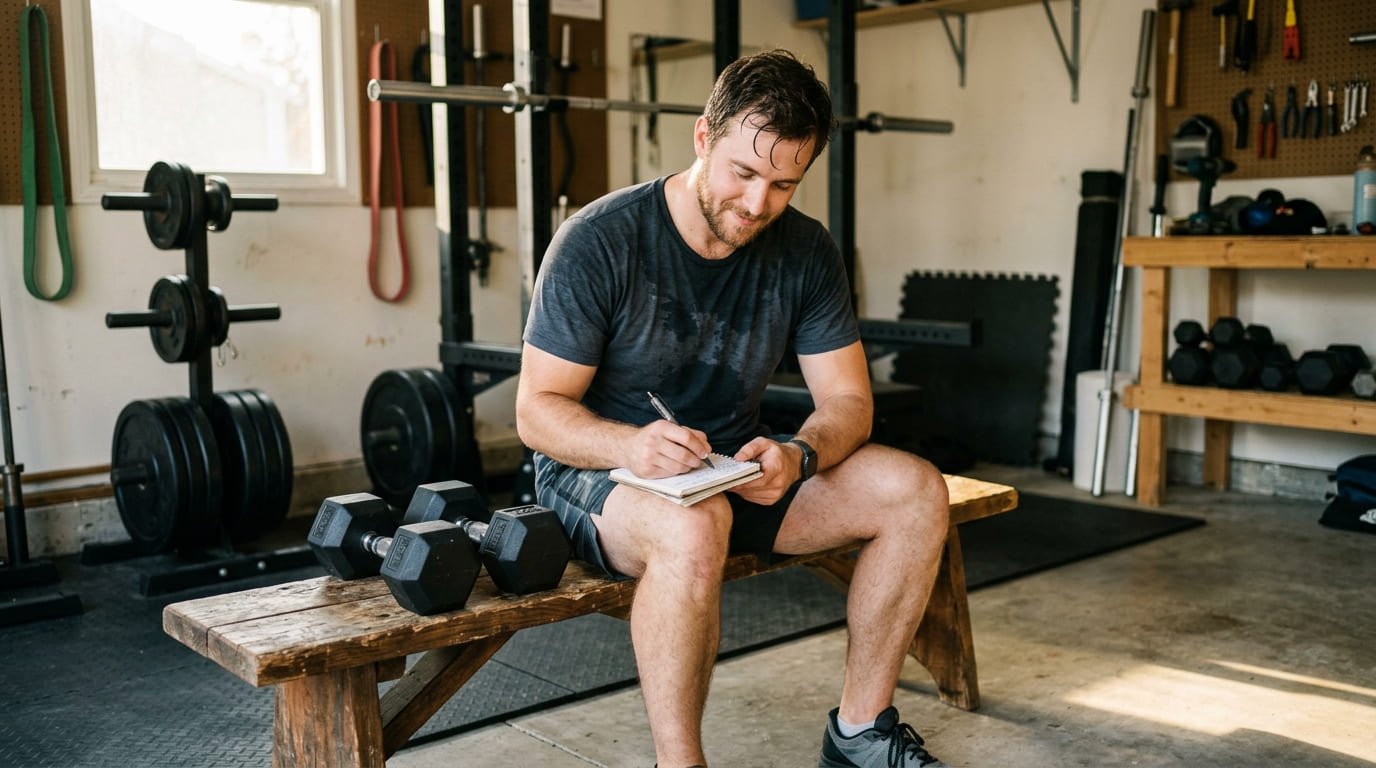
The single most useful habit is writing down what you lift. Not a detailed spreadsheet, just exercise, weight, sets and reps. Four weeks of a training log tells you more about whether your programme works than any amount of soreness ever will.
If your log shows you are adding reps or weight every couple of weeks, your training is working, regardless of how you feel the next morning.
When a lack of soreness does matter
Soreness alone is never the signal. Soreness combined with a lack of progress is.
Ask yourself these questions:
- Am I lifting more weight, or more reps, than I was a month ago? If yes, you are fine. Stop worrying about this
- Am I stopping sets with several reps still in me? Most beginners significantly underestimate how close they are to failure. Aim to finish most sets with one to three reps left
- Have I used the same weights for two months or more? That is a progressive overload problem, not a soreness problem
- Am I doing the same exercises in the same order every single session? Some variation helps, though far less than people think
- Is my range of motion full? Half-range reps reduce both the stimulus and the soreness
- Am I actually recovering, or just doing very little? There is a difference between efficient training and easy training
If the answer to the first question is yes, everything is working. If you have not added weight or reps in two months, that is the thing to fix, and the fix is progressive overload rather than chasing soreness.
Never make a session harder purely to create soreness. Deliberately adding damaging work, like unfamiliar high-volume eccentrics, produces soreness and fatigue that interferes with the next few sessions without improving results.
If you want to be more sore, and why you probably should not
You can reliably produce soreness. It is easy. Change exercises frequently, add slow eccentrics, train through a very deep range, and increase volume sharply.
But consider what that costs. Soreness impairs performance in your next session, reduces range of motion temporarily, and makes it more likely you will skip a workout. Chasing it means constantly starting over on new exercises rather than progressing on familiar ones, which is one of the more reliable ways to make slow progress.
The trade-off is worth stating plainly: novelty causes soreness, familiarity causes progress. Some variation is useful, but a programme you repeat and progress on beats a different workout every session.
Our guide on how to reduce muscle soreness covers the other side of this if you are currently dealing with too much of it.
Why some exercises make you sore and others never do
Soreness varies enormously by exercise, and it has almost nothing to do with how much each one contributes to your progress.
| Exercise type | Typical soreness | Why |
|---|---|---|
| Romanian deadlifts, deep lunges, Nordic curls | Very high | Heavy load in a lengthened position, strong eccentric component |
| Squats and deep push-ups | Moderate to high | Long range with a loaded stretch at the bottom |
| Downhill running and plyometrics | Very high | Repeated high-force eccentric landings |
| Overhead press, rows, curls | Low to moderate | Shorter range, less loaded stretch |
| Cycling, rowing, sled pushes | Very low | Almost entirely concentric, little muscle lengthening under load |
| Isometric holds, planks, carries | Very low | No lengthening at all, so minimal fibre damage |
| Machine work with a fast lowering phase | Low | The eccentric is rushed rather than controlled |
Look at that list and notice something: carries, sled pushes and rowing produce almost no soreness and are all excellent training. Meanwhile a set of deep lunges you have never done before will wreck you for three days without necessarily building more muscle than the squats you already do well.
This is the clearest illustration of why soreness cannot be used as a quality signal. It tells you which movement pattern you used and how new it was, and very little else.
Soreness and fat loss are unrelated
Worth stating separately because it comes up constantly.
Soreness tells you nothing about how many calories you burned. A 45-minute walk burns real energy and produces no soreness whatsoever. Twenty minutes of unfamiliar lunges may leave you sore for days while burning considerably less.
Fat loss is driven by your overall energy balance across the week, primarily through your food intake, your daily movement and step count, and your structured training. None of those three are measured by how your legs feel the next day. If fat loss is your goal, track your weight trend over weeks and your step count, not your soreness.
What soreness normally looks like over time
| Training stage | Typical soreness | What it means |
|---|---|---|
| First 1 to 2 weeks | Significant, often after every session | Everything is novel |
| Weeks 3 to 6 | Moderate, mainly after new exercises | Repeated bout effect kicking in |
| Weeks 6 to 12 | Mild and occasional | You are adapted, this is normal and good |
| Beyond 3 months | Rare, mainly after a break or a new exercise | Expected, not a problem |
| After a week or two off | Returns noticeably | Detraining reduces the protective effect |
That progression is the normal, healthy pattern. If you are three months into consistent training and no longer sore, you are exactly where you should be.
Signals that matter more than soreness
Instead of soreness, pay attention to these, because they tell you something actionable.
- Sharp or joint pain during a movement. This is a stop signal, unlike muscle soreness
- Soreness lasting beyond 72 hours, which usually means you increased volume too quickly
- Persistent fatigue, poor sleep and declining performance across several sessions, which suggests you are accumulating more fatigue than you recover from
- Loss of motivation combined with stalled numbers, which often means a lighter week is due
- Severe soreness with dark urine and swelling, which is rare but needs urgent medical attention
If you are consistently exhausted after training rather than sore, that is a different question, covered in our guide on feeling tired after a workout.
If you are new to training
Two specific things worth knowing if you are in your first few months.
You will be sore at first, and then you will not be. This is not a sign your training stopped working. It is the single clearest sign that your body has adapted, which is the entire point.
Beginners make rapid progress with modest soreness. The first few months of training produce fast strength gains, much of it from your nervous system learning to recruit muscle more efficiently. That process is almost entirely unrelated to soreness.
The most productive thing you can do in your first three months is repeat the same handful of exercises, get better at them, and add a little weight or a rep whenever you can. Our home workouts for beginners guide sets that structure out.
How to tell if you are actually training hard enough
Since soreness will not tell you, here is what will. The most practical tool is reps in reserve, meaning how many more reps you could have completed at the end of a set.
| How the set felt | Reps in reserve | Is this productive? |
|---|---|---|
| Could have done 6 or more reps | 6 or more | No, too easy to drive much adaptation |
| Could have done 4 to 5 more | 4 to 5 | Marginal, useful only for technique practice |
| Could have done 2 to 3 more | 2 to 3 | Yes, a good working range for most sets |
| Could have done 1, bar speed slowed | 1 | Yes, productive but more fatiguing |
| Could not have done another rep | 0 | Effective, but use sparingly |
Most beginners consistently overestimate how hard they are working. A useful check: on your last set of an exercise, keep going past where you would normally stop and count the extra reps. If you managed five more than usual, your normal sets are too easy, and that is the thing to change.
Two other reliable signs a set was productive: the last two or three reps were noticeably slower than the first ones, and you needed a proper rest before the next set rather than being ready immediately.
Five mistakes this worry leads to
- Changing your programme constantly to chase soreness, which prevents you from progressing on anything
- Adding volume you cannot recover from, making every session worse than the last
- Assuming a session was wasted and doubling up the next day
- Using soreness as the only feedback instead of keeping a training log
- Ignoring genuine plateaus because you are focused on how you feel rather than what you lift
The bottom line
Not being sore after a workout is usually good news. It means your body has adapted to the work, which is exactly what training is supposed to produce. Soreness measures novelty and muscle damage, not effectiveness, and muscle growth runs on mechanical tension rather than on how much you ache.
The only version of this worth acting on is no soreness combined with no progress. So stop using soreness as your feedback and start using a training log. If the weight on the bar, or the reps at that weight, is higher than it was a month ago, your training is working. That is the answer, and it is a far more reliable one than how your legs feel on the stairs.
Frequently asked questions
Is it bad if I am not sore after a workout?
No. Soreness reflects muscle damage and how unfamiliar the exercise was, not how effective the session was. Muscle growth is driven mainly by mechanical tension, which you can produce without causing damage. A lack of soreness usually means your body has adapted to the training, which is the goal.
Am I still building muscle if I am not sore?
Yes. Muscle growth depends on sufficient load, effort and volume applied consistently over time, not on soreness. Well-trained lifters are rarely sore and continue building muscle for years. The reliable test is your training log: if you are lifting more weight or completing more reps than a month ago, you are progressing.
Why was I sore at first but not anymore?
This is the repeated bout effect. After one session of a given exercise, your muscles adapt so that the same session causes considerably less damage next time. Your first weeks of any new routine produce noticeable soreness, and that fades within four to six weeks even as you lift heavier weights.
Should I train harder if I am not sore?
Only if your numbers have stalled. Check whether you have added weight or reps in the past month. If you have, your training is working and there is nothing to fix. If you have used the same weights for two months, the problem is a lack of progressive overload, not a lack of soreness.
Does soreness mean muscle growth?
No. Soreness indicates muscle damage and inflammation, which is a side effect of training rather than the mechanism that drives growth. Exercises that produce a lot of soreness, such as heavy eccentric work and unfamiliar movements, are not automatically better for building muscle than familiar exercises you progress on steadily.
How do I know if my workout was effective without soreness?
Track load, reps, total volume, technique quality, recovery speed and monthly body measurements. A simple written log of exercise, weight, sets and reps is the single most useful habit. Four weeks of that data tells you far more about whether your programme works than soreness ever could.
Why do some people get sore and others do not?
Individual variation is considerable and partly genetic, relating to differences in inflammatory response and muscle fibre characteristics. Training history, exercise selection, sleep, protein intake and hydration also influence it. Two people can perform an identical session with completely different soreness outcomes.
Is it better to be sore or not sore?
Not sore, generally. Soreness reduces performance in your next session, temporarily limits range of motion and makes skipping workouts more likely. Some mild soreness after new exercises is normal and harmless, but deliberately chasing it means constantly switching exercises rather than progressing on them.


