Can You Train Abs Every Day? How Often to Work Your Core
You can do light core work every day, but most people get better results training their abs properly two to four times a week, with rest days in between. Your abs are muscles like any other. They get stronger when you challenge them and then let them recover, and doing hundreds of crunches daily usually leads to boredom and a sore neck rather than a six-pack.
When I started working out, I did a 10-minute ab routine every single morning for two months, convinced it was the fastest route to visible abs. My core got a bit stronger, but my stomach looked exactly the same. It took me an embarrassingly long time to learn two things: abs need recovery like everything else, and whether you can see them has almost nothing to do with how often you train them.
This guide covers how often to train your abs, what’s fine to do daily and what isn’t, why visible abs come from somewhere else entirely, and a weekly plan you can actually follow.
At a glance
- Can you train abs every day? Light core work, yes. Hard ab workouts, better not
- Best frequency: 2 to 4 proper core sessions a week
- Session length: 10 to 20 minutes is plenty
- Daily-friendly moves: planks, dead bugs, bird dogs, gentle mobility
- Needs rest days: weighted crunches, hanging leg raises, hard ab circuits
- Visible abs depend on: body fat, not training frequency
- Bonus: squats, deadlifts and push-ups already work your core
The short answer
| Type of core work | Every day? | Why |
|---|---|---|
| Gentle planks, dead bugs, bird dogs | Yes, if you like | Low load, recovers quickly |
| Easy ab mobility and breathing drills | Yes | Very low demand |
| Bodyweight crunches and leg raises, moderate volume | Most days is fine, but rest days help | Moderate load |
| Hard ab workouts to the point of burning out | 2 to 4 times a week | Needs recovery like any other muscle |
| Weighted ab exercises | 2 to 3 times a week | Higher load, more recovery needed |
So the honest answer to “can you work abs every day?” is yes and no. You can move your core every day. You shouldn’t hammer it every day.
Why your abs need rest days
There’s an old idea that abs are “different” and recover faster than other muscles, so you can train them daily. There’s a small grain of truth in it. Your core works constantly to keep you upright, and it’s used to low-level activity. But that doesn’t mean it enjoys being trained hard every single day.
When you do a genuinely challenging ab workout, you create the same kind of small muscle damage and fatigue as any other workout. Strength gains happen during recovery, not during the session itself. If you never give the muscles time to recover, you tend to:
- Plateau, because the muscles never fully adapt
- Get sloppier technique as fatigue builds up day after day
- Feel it more in your neck and hip flexors as your abs tire
- Get bored, which is honestly the most common reason people quit
Training your abs hard on some days and resting them on others gives them the chance to actually get stronger.
What your core actually does
Part of the reason daily crunches don’t do much is that crunches only train one of the jobs your core has. Once you know all of them, it’s easier to build a routine that actually makes your core strong and useful.
| Core job | What it means | Example exercises |
|---|---|---|
| Bending your spine forwards | Curling your ribs towards your hips | Crunches, reverse crunches |
| Resisting arching | Keeping your lower back from sagging | Planks, dead bugs, ab wheel rollouts |
| Resisting twisting | Staying square when something tries to rotate you | Plank shoulder taps, bird dogs, Pallof-style holds |
| Resisting side bending | Staying upright when loaded on one side | Side planks, suitcase carries |
| Rotating | Turning your torso with control | Bicycle crunches, Russian twists |
In everyday life, the “resisting” jobs matter most. Your core spends far more time stopping unwanted movement, such as keeping your back steady while you carry shopping or pick up a child, than it does curling you forwards. That’s why a good core routine includes planks, side planks and anti-rotation work, not just crunches.
It also explains why a lot of back discomfort improves with core training that focuses on stability rather than endless sit-ups.
A 5-minute daily core routine
If you enjoy doing something every day, this is the kind of routine that’s gentle enough to repeat daily without getting in the way of your harder sessions. Keep every rep slow and controlled.
| Exercise | Reps or time |
|---|---|
| Dead bugs | 8 slow reps per side |
| Bird dogs | 8 per side, pausing for 2 seconds at the top |
| Side plank on your knees | 15 to 20 seconds per side |
| Glute bridge | 12 reps |
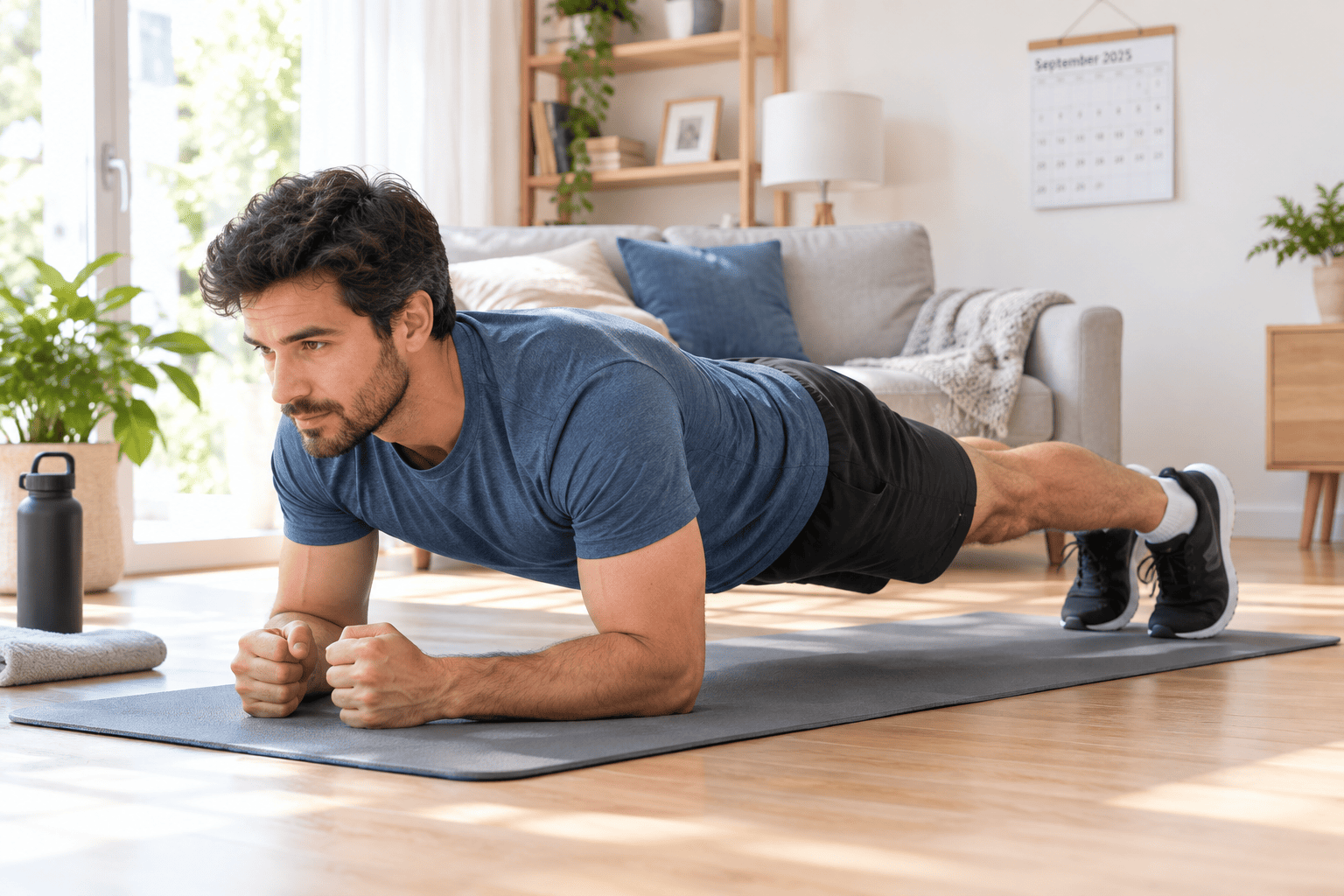
| Front plank | 20 to 30 seconds |
It takes about five minutes and it shouldn’t leave you sore. Think of it as practice rather than a workout. It works particularly well first thing in the morning or as part of your warm-up before other training.
A 4-week core progression for beginners
If you’re starting from scratch, here’s a simple way to build up without doing too much too soon.
| Week | Main core sessions | Other days |
|---|---|---|
| Week 1 | 2 sessions of 10 minutes, easy exercises | Rest or the 5-minute routine |
| Week 2 | 2 sessions of 10 to 12 minutes, add a set | 5-minute routine on 2 or 3 days |
| Week 3 | 3 sessions of 12 minutes, add side planks and reverse crunches | Rest or 5-minute routine |
| Week 4 | 3 sessions of 15 minutes, add harder variations | Rest or 5-minute routine |
Progress by adding a few seconds to holds, a couple of reps to each set, or moving to a harder variation, rather than simply doing more sessions. After a month, most people notice planks feel easier, their lower back feels steadier and bodyweight ab exercises no longer wipe them out.
How often should you train your abs?
For most people, two to four focused core sessions a week works best. Here’s how that looks at different levels:
| Level | Core sessions per week | Length | Intensity |
|---|---|---|---|
| Complete beginner | 2 to 3 | 10 minutes | Easy to moderate |
| A few months in | 3 | 10 to 15 minutes | Moderate |
| Regular trainer | 3 to 4 | 15 to 20 minutes | Moderate to hard, some weighted work |
| Advanced | 2 to 4 | 15 to 20 minutes | Hard, including loaded exercises |
You can put these sessions at the end of your normal workouts, or do them on their own on non-consecutive days. If you want a ready-made session, my 15-minute ab workout is a good fit for two or three times a week.
What you can safely do every day
Light, controlled core exercises that don’t wipe you out are fine daily for most people. They’re great as a morning habit or a warm-up before other training.
- Dead bugs: 1 to 2 sets of 8 to 10 slow reps per side
- Bird dogs: 1 to 2 sets of 8 per side
- Planks: a couple of 20 to 30 second holds
- Side planks: 1 to 2 holds of 15 to 20 seconds per side
- Glute bridges: 1 to 2 sets of 12 to 15
- Breathing drills: slow belly breathing lying on your back with knees bent
Keep these easy. If they leave your abs sore the next day, you’re doing too much for a daily routine. My guide to the beginner core workout has clear instructions for all of these.
What you shouldn’t do every day
These are better with at least a day of rest between sessions:
- High-rep crunch or sit-up circuits that leave your abs burning
- Hanging leg raises and toes-to-bar
- Weighted crunches, weighted Russian twists and other loaded exercises
- Ab wheel rollouts
- Long ab challenges that push you to failure
If you’re adding weight to your ab training, my guide to the ab workout with dumbbells includes sensible sets and reps.
Why training abs every day won’t give you visible abs
This is the part that frustrated me most when I was starting out, so I want to be really clear about it.
Everyone already has abdominal muscles. Whether you can see them depends mostly on how much body fat covers them, not on how strong they are or how often you train them. You can have a very strong core and no visible abs at all, and you can have visible abs without doing much direct ab training.
You also can’t burn fat from your stomach specifically by working your abs. Spot reduction doesn’t work. Doing more crunches strengthens the muscle underneath, but the fat on top is lost through your overall calorie balance across the whole body.
If visible abs are your goal, these matter far more than daily ab workouts:
- Your overall body fat level, which mostly comes down to eating
- Consistent full body training, including strength work
- Daily activity, like walking
- Sleep and stress, which affect appetite and fat storage
- Patience, because it usually takes months
My guide to the body fat percentage where abs show gives realistic numbers, and how to get a flat stomach covers what actually works.
Your core already works in other exercises
Many exercises train your core even though they’re not “ab exercises”. When you do these properly, your abs and deeper core muscles are working hard to keep your spine stable:
- Squats and goblet squats
- Deadlifts and Romanian deadlifts
- Push-ups and plank variations
- Overhead presses
- Lunges and split squats
- Carrying heavy shopping bags or dumbbells
That’s another reason you don’t need daily direct ab training. If you’re doing a full body strength workout a few times a week, your core is already getting a lot of work.
A simple weekly core plan
Here’s a plan that trains your abs well without overdoing it. It assumes you’re doing some other workouts during the week too.
| Day | Core focus | Example |
|---|---|---|
| Monday | Main core session | Crunches, leg raises, plank, dead bugs |
| Tuesday | Light daily core | Dead bugs and bird dogs, 5 minutes |
| Wednesday | Obliques and stability | Side planks, bicycle crunches, Pallof-style holds |
| Thursday | Light daily core or rest | Plank holds, 5 minutes |
| Friday | Main core session | Reverse crunches, mountain climbers, plank shoulder taps |
| Saturday | Light daily core or rest | Glute bridges and breathing drills |
| Sunday | Rest | Walk or gentle stretching |
If you want to target different areas, my guides to lower ab workouts, upper ab workouts and oblique exercises each have sessions you can slot into the main days.
Signs you’re training your abs too often
- Your abs feel sore most of the time
- Your ab workouts are getting weaker instead of stronger
- You feel it more in your neck or hip flexors than your abs
- Your lower back aches after ab sessions
- You’re dreading your ab routine
If any of these sound familiar, cut back to two or three proper sessions a week, and keep the other days light or completely off. If your back hurts during ab exercises, stop the exercises that cause it and focus on stability moves like dead bugs and bird dogs.
Is it okay to train sore abs?
Mild soreness is fine for light core work, such as dead bugs, bird dogs and gentle planks. Moving can even help you feel better. But if your abs are very sore, especially if it hurts to laugh or sit up, skip hard ab training until the soreness eases.
Delayed soreness usually peaks one to two days after a hard session and fades within a few days. My guide on how to reduce muscle soreness covers what actually helps if it’s getting in the way.
How long should an ab workout be?
For most people, 10 to 20 minutes is plenty. Quality matters far more than length. A focused 10-minute session with slow, controlled reps will do more than a rushed 30-minute session of sloppy crunches.
| Goal | Session length | Exercises |
|---|---|---|
| Quick daily core habit | 5 minutes | 2 to 3 easy moves |
| Beginner core session | 10 minutes | 3 to 4 exercises, 2 to 3 sets |
| Standard ab workout | 15 minutes | 4 to 5 exercises, 3 sets |
| Harder or weighted session | 15 to 20 minutes | 4 to 5 exercises including loaded moves |
Common ab training mistakes
- Doing only crunches. Your core also resists rotation and bending, so include planks and side planks.
- Pulling on your neck. Keep your hands lightly by your head, or cross them on your chest.
- Rushing the reps. Slow, controlled reps work better than fast, bouncy ones.
- Training abs to failure every day. Leave a couple of reps in reserve most sessions.
- Expecting abs to show from training alone. It’s mostly about body fat.
- Ignoring your lower back. A strong core includes your back muscles too.
Do you need equipment for core training?
No. Almost everything your core needs can be trained with body weight on a mat. Equipment becomes useful later, once bodyweight exercises get easy.
| Equipment | What it adds | When it helps |
|---|---|---|
| None | Planks, dead bugs, crunches, leg raises | Everyone, especially beginners |
| Dumbbell | Weighted crunches, suitcase carries, weighted dead bugs | Once 3 sets of 15 feel easy |
| Resistance band | Anti-rotation holds, banded dead bugs | Adding rotation-resistance work at home |
| Ab wheel | Rollouts, a very hard anti-extension exercise | Intermediate and above |
| Exercise ball | Stir the pot, ball crunches | Adding instability and variety |
A dumbbell and a resistance band cover almost everything. Ab gadgets sold with promises of quick results rarely do more than a mat and some patience.
Core training as you get older
Core training becomes more valuable with age, not less. A strong, stable core helps with balance, getting up from chairs, carrying shopping and protecting your back during everyday tasks.
The main adjustments are simple. Favour stability exercises like dead bugs, bird dogs and supported planks over repeated sit-ups, which can be hard on the neck and back. Progress more gradually, and give yourself an extra rest day between harder sessions. If you have osteoporosis, back problems or you’ve had abdominal surgery, get advice on which exercises suit you before starting. My guide to core exercises for seniors covers seated, standing and floor options.
If ab exercises hurt your lower back
This is common, and it usually means the exercise is too hard right now or your lower back is doing the work your abs should be doing.
- Leg raises and sit-ups are the usual culprits, because your hip flexors pull on your lower back as your abs tire. Swap them for reverse crunches or dead bugs.
- Planks that sag put stress on the lower back. Drop to your knees or shorten the hold until your back stays flat.
- Flatten your back gently into the floor during lying exercises, and stop the set as soon as it starts to arch.
- Slow down. Momentum is what usually lets the back take over.
If you have ongoing back pain, especially pain that travels into your legs, get it assessed before building a core routine around it. Stability exercises often help, but the right plan depends on the cause.
The bottom line
You can do gentle core work every day, but you’ll usually get better results training your abs properly two to four times a week with rest in between. Keep sessions to 10 to 20 minutes, mix up the types of core exercise, and remember that your core also works hard during squats, push-ups and other big movements.
If your goal is visible abs, the answer isn’t more ab training. It’s consistent overall training, sensible eating and patience. Build a strong core, look after the rest of your routine, and the results will follow.
If you want to take your core training further with body weight alone, my calisthenics core workout covers 12 exercises and a progression to hanging leg raises and the L-sit.
Frequently asked questions
Can you work out your abs every day?
You can do light core work every day, such as dead bugs, bird dogs and gentle planks. Hard ab workouts, especially weighted exercises or high-rep circuits, work better two to four times a week with rest days in between so the muscles can recover and get stronger.
How often should you work out your abs?
Most people do best with two to four focused core sessions a week, each lasting about 10 to 20 minutes. Beginners can start with two or three sessions a week and add more as their core gets stronger.
Will doing ab workouts every day give me a six-pack?
Not on its own. Everyone has abdominal muscles, but whether you can see them depends mainly on your body fat level. Daily ab workouts strengthen the muscles but don’t burn fat from your stomach specifically.
Is it bad to do crunches every day?
Doing a few gentle crunches daily isn’t harmful for most people, but high-rep crunch routines every day often lead to neck strain, boredom and a plateau. Mixing in planks and other core exercises, with rest days, works better.
Do abs need rest days?
Yes, especially after hard or weighted ab workouts. Abs are muscles like any other, and they get stronger during recovery. Light core exercises can be done on rest days, but give them at least a day off from intense training.
How long should an ab workout be?
Ten to twenty minutes is plenty for most people. A focused session of three to five exercises with slow, controlled reps is more effective than a long session of rushed crunches.
Can I train abs when they are sore?
Light core work like dead bugs and gentle planks is fine with mild soreness. If your abs are very sore, especially if it hurts to sit up or laugh, skip hard ab training until the soreness eases, usually within a few days.
Do squats and deadlifts work your abs?
Yes. Squats, deadlifts, push-ups, overhead presses and carrying exercises all require your core to work hard to keep your spine stable. If you do these regularly, you need less direct ab training than you might think.
Source: NHS, Physical activity guidelines for adults aged 19 to 64