Tech Neck Exercises: 10 Moves for Neck Hump, Forward Head Posture and Stiffness
Tech neck exercises have become one of the most searched fitness topics of the smartphone age, and it is easy to see why. Most of us spend hours a day looking down at phones, laptops and tablets. Over time, the head drifts forward, the upper back rounds, and the neck starts to ache. Some people also notice a soft bump at the base of the neck, often called a neck hump.
The encouraging news is that tech neck is largely a habit problem, and habits can be changed. A short daily routine of mobility and strengthening exercises, combined with a few changes to how you use your devices, can make your neck feel much more comfortable and help you hold your head in a better position.
This guide explains what tech neck and neck hump are, what the research says, 10 tech neck exercises you can do at home or at your desk, a 10-minute daily routine, device and desk habits that help, and the warning signs that mean you should see a professional.
At a glance
- Tech neck is neck and upper back discomfort linked to long periods of looking down at screens
- The head moves forward, the upper back rounds and the neck muscles work harder to hold it up
- A neck hump is usually a soft tissue fat pad at the base of the neck, often linked with posture
- The best tech neck exercises combine chin tucks, upper back mobility and shoulder blade strengthening
- Research suggests strengthening exercises for the neck and shoulder region can help chronic neck pain
- Changing how you hold your phone and set up your desk matters as much as the exercises
- See a doctor for neck pain with numbness, weakness, severe headaches or after an injury
What is tech neck?
Tech neck describes neck, shoulder and upper back discomfort caused or made worse by spending long periods looking down at devices. When you look down, your head moves forward of your shoulders and your neck muscles have to work harder to hold it up.
| Common sign | What it feels like |
|---|---|
| Neck stiffness | Tightness when turning or tilting your head |
| Upper back ache | Aching between or across the shoulder blades |
| Forward head position | Ears sitting in front of the shoulders when viewed from the side |
| Rounded shoulders | Shoulders drifting forward |
| Tension headaches | Pressure at the base of the skull or around the forehead |
| Neck hump | A soft bump at the base of the neck |
How much does looking down load the neck?
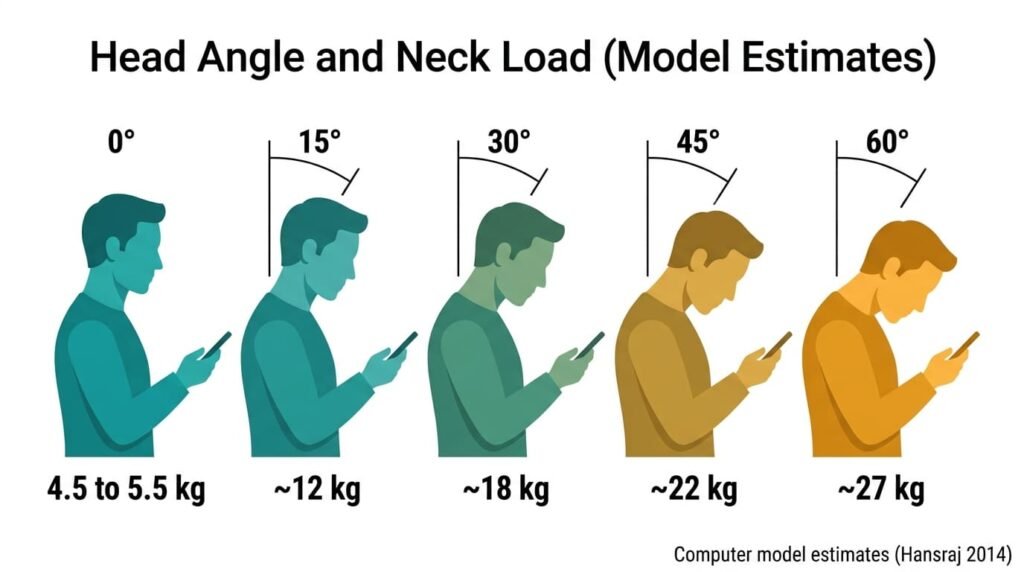
A widely cited modelling study estimated the load on the neck at different head angles. An adult head weighs roughly 4.5 to 5.5 kg (10 to 12 lb) in a neutral position. As the head tilts forward, the estimated load on the neck rose sharply: around 12 kg at 15 degrees, 18 kg at 30 degrees, 22 kg at 45 degrees and 27 kg at 60 degrees.
This was a computer model, not a measurement in real people, so treat the exact numbers with caution. But the principle is useful: the further your head drops forward, the harder your neck muscles have to work, especially when you hold that position for hours.
| Head angle (estimate) | Approximate load on the neck |
|---|---|
| Neutral (0 degrees) | 4.5 to 5.5 kg (10 to 12 lb) |
| 15 degrees forward | About 12 kg (27 lb) |
| 30 degrees forward | About 18 kg (40 lb) |
| 45 degrees forward | About 22 kg (49 lb) |
| 60 degrees forward | About 27 kg (60 lb) |
What is a neck hump?
A neck hump, sometimes called a dowager’s hump or buffalo hump, is a rounded area at the base of the neck. In most people, it is mainly a pad of soft tissue and fat that becomes more noticeable with forward head posture and a rounded upper back.
Less commonly, a pronounced hump can be caused by changes in the spine itself, such as compression fractures from osteoporosis, or by medical conditions such as hormonal disorders. If your hump appeared quickly, is getting worse, is painful, or comes with other symptoms, see a doctor.
For posture-related neck humps, neck hump exercises cannot remove fat from that specific spot, but improving your posture and strengthening the muscles of the upper back and neck can make the area less prominent and more comfortable.
What the research says
A Cochrane review of 27 trials with 3,005 participants looked at exercise for mechanical neck disorders. It found no high-quality evidence, but concluded that specific strengthening exercises for the neck, shoulder and shoulder blade region may be beneficial for chronic neck pain, cervicogenic headache and radiculopathy. Stretching on its own showed less consistent benefit.
The message for tech neck: combine mobility work with strengthening, especially for the deep neck flexors and the muscles around the shoulder blades, and keep at it for several weeks.
10 tech neck exercises and forward head posture exercises
Do these slowly and gently. They should feel like mild stretching or muscle work, never sharp pain.
1. Chin tucks
Sit or stand tall. Without tilting your head up or down, gently glide your chin straight back, as if making a double chin. Hold for 5 seconds, then relax. Do 10 reps. This is the most important of all forward head posture exercises. It strengthens the deep neck flexors at the front of the neck.
2. Lying chin tuck with head lift
Lie on your back. Do a chin tuck, then lift your head just a centimetre off the floor and hold for 5 to 10 seconds. Lower and relax. Do 5 to 10 reps. A harder version once standing chin tucks are easy.
3. Wall angels
Stand with your back, head and bottom against a wall. Raise your arms into a goalpost shape, backs of your hands toward the wall. Slowly slide your arms up and down, keeping as much contact with the wall as is comfortable. Do 10 reps. It opens the chest and works the upper back.
4. Thoracic open book
Lie on your side with knees bent and arms straight in front of you. Keeping your knees together, open your top arm across your body until it reaches the other side, following it with your eyes. Return slowly. Do 8 per side. Upper back stiffness often drives forward head posture. Our guide to thoracic mobility exercises has more options.
5. Seated thoracic extension
Sit in a chair with a firm back that reaches about mid-back height. Place your hands behind your head and gently lean back over the top of the chair, then return. Do 10 slow reps.
6. Band rows
Anchor a band at chest height. Pull your elbows back, squeezing your shoulder blades together, then return slowly. Do 2 to 3 sets of 12 to 15. Strengthening the upper back helps hold the shoulders and head in a better position.
7. Prone Y raises
Lie face down with your arms overhead in a Y shape, thumbs up. Lift your arms a few centimetres, squeezing your lower shoulder blade muscles, then lower. Do 2 sets of 10. Our lower trap exercises guide explains why these muscles matter for posture.
8. Band pull-aparts
Hold a light band in front of you at shoulder height. Pull it apart, squeezing your shoulder blades together, then return. Do 2 sets of 15.
9. Doorway chest stretch
Place your forearms on either side of a doorway at shoulder height and step one foot forward until you feel a stretch across your chest. Hold for 30 seconds, twice. Tight chest muscles pull the shoulders forward.
10. Upper trapezius and levator stretch
Sit tall and hold the edge of your chair with one hand. Gently tilt your head away from that side, ear toward shoulder, until you feel a stretch. Hold 20 to 30 seconds. Then turn your nose toward the opposite armpit and gently look down for the levator scapulae stretch. Repeat on the other side.
| Exercise | Focus | Dose |
|---|---|---|
| Chin tucks | Deep neck flexors | 10 x 5-second holds |
| Lying chin tuck with head lift | Deep neck flexors, harder | 5 to 10 x 5 to 10 seconds |
| Wall angels | Chest opening, upper back | 10 slow reps |
| Thoracic open book | Upper back rotation | 8 per side |
| Seated thoracic extension | Upper back extension | 10 reps |
| Band rows | Upper back strength | 2 to 3 x 12 to 15 |
| Prone Y raises | Lower traps | 2 x 10 |
| Band pull-aparts | Rear shoulders, upper back | 2 x 15 |
| Doorway chest stretch | Chest flexibility | 2 x 30 seconds |
| Upper trap and levator stretch | Neck tension | 20 to 30 seconds per side |
A 10-minute routine of exercises for tech neck
| Order | Exercise | Dose |
|---|---|---|
| 1 | Chin tucks | 10 x 5 seconds |
| 2 | Thoracic open book | 8 per side |
| 3 | Wall angels | 10 |
| 4 | Band rows | 2 x 12 |
| 5 | Band pull-aparts | 15 |
| 6 | Doorway chest stretch | 30 seconds |
| 7 | Upper trap stretch | 20 seconds per side |
Do this once a day, ideally after long periods of screen use. Add prone Y raises and lying chin tucks two or three times a week as you get stronger.
Desk and device habits
| Habit | How to do it |
|---|---|
| Raise your phone | Hold it closer to eye level, elbows resting on your body or a table |
| Use your eyes, not your neck | Lower your gaze rather than dropping your whole head |
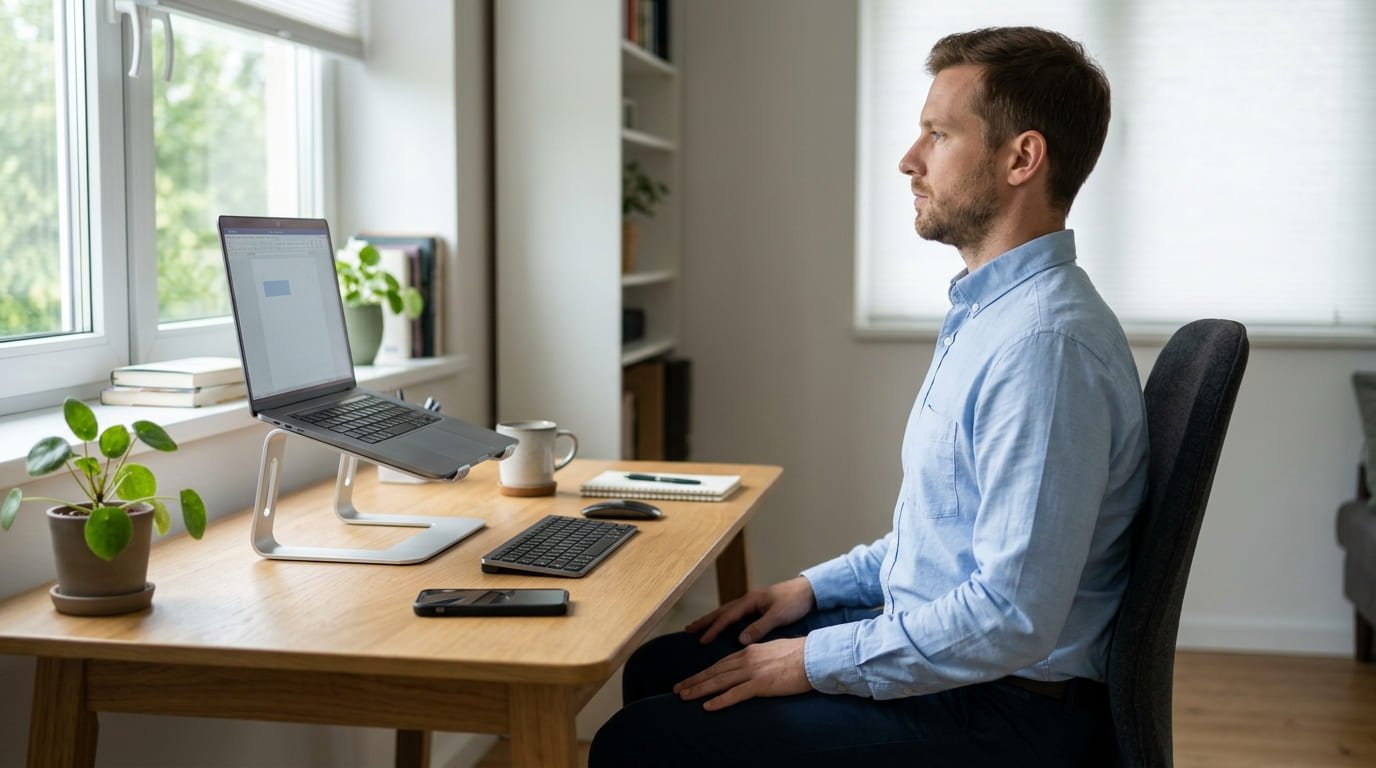
| Screen at eye level | Top of a monitor at or just below eye level, about an arm’s length away |
| Laptop stand and separate keyboard | Lifts the screen so you do not look down |
| Chair support | Back supported, feet flat, hips slightly higher than knees |
| Regular breaks | Every 30 to 45 minutes, stand up and do 5 chin tucks and a shoulder roll |
| Limit long scrolling sessions | Set a timer or use screen time reminders |
The exercises help, but these habits address the cause. Even small changes, like raising your phone a few inches, reduce how long your head spends in a forward position.
A 6-week plan of tech neck exercises
| Weeks | Focus |
|---|---|
| 1 and 2 | Daily routine, set up your desk and phone habits |
| 3 and 4 | Add prone Y raises and lying chin tucks 3 times a week, stronger band |
| 5 and 6 | Add a full upper back strength session twice a week, keep the daily routine |
For a full strength session, our posture exercises guide and our mid back exercises guide work well alongside this routine.
Sleep and neck comfort
A pillow that keeps your neck in line with your spine helps. Back sleepers usually need a lower pillow, side sleepers a slightly higher one so the head does not tilt. Sleeping on your stomach twists the neck for hours, so try to avoid it if your neck is sore.
When to see a doctor
See a doctor or physiotherapist if you have:
- Numbness, tingling or weakness in your arms or hands
- Severe or worsening headaches, especially with other symptoms
- Neck pain after a fall, accident or injury
- A neck hump that appeared quickly, is growing, or is painful
- Pain that wakes you at night or has not improved after a few weeks
- Fever, unexplained weight loss or feeling generally unwell with neck pain
This article is general information, not medical advice. See our medical disclaimer.
Common mistakes with tech neck exercises
| Mistake | What happens | Fix |
|---|---|---|
| Only stretching | Little long-term change | Add strengthening exercises |
| Pushing chin tucks too hard | Neck strain | Gentle glide, no forcing |
| Doing exercises but ignoring habits | The cause continues | Fix phone and desk set-up |
| Expecting overnight change | Frustration | Give it 6 weeks or more |
| Cracking your neck forcefully | Short relief, possible irritation | Use gentle movement instead |
2-minute desk break for tech neck
When you have been at a screen for 30 to 45 minutes, try this quick routine without leaving your chair:
- 5 chin tucks, holding each for 5 seconds
- 10 shoulder rolls backward
- 5 shoulder blade squeezes, holding each for 5 seconds
- Seated thoracic extension over the chair back, 5 slow reps
- Look out of a window or across the room for 20 seconds to rest your eyes
These small, frequent breaks are some of the most effective exercises for tech neck, because they interrupt long periods in the same position.
Tech neck in students and teenagers
Students often spend hours looking down at phones, laptops and textbooks. Encourage regular breaks, a raised laptop for homework, and active hobbies that get the upper back working, such as swimming, climbing or racket sports. The same chin tucks and wall angels work well for younger people, and building good habits early makes a big difference later.
Gamers and remote workers
Long gaming sessions and full days of video calls keep the head forward for hours. A raised screen, a chair with good back support, and a timer reminding you to move every 45 minutes help a lot. Add two short upper back strength sessions a week, such as rows and Y raises, to balance all that sitting.
Why strength matters as much as stretching
Stretching tight chest and neck muscles feels good, but the relief often fades quickly if the muscles that hold you upright stay weak. The deep neck flexors, lower traps and upper back muscles need strengthening to support a better head and shoulder position for longer periods. That is why this routine combines both. Our rotator cuff exercises guide adds more shoulder blade strength work if you want to go further.
A quick posture self-check
Stand with your back against a wall, heels a few centimetres away. Your bottom and upper back should touch the wall. Notice whether the back of your head touches the wall comfortably without tilting your chin up. If it does not, you likely have some forward head posture. Repeat this check every two weeks to track your progress with your neck hump exercises and daily routine.
How to hold your phone
| Habit | Instead try |
|---|---|
| Phone in your lap, head bent down | Hold the phone at chest or eye level |
| One arm holding the phone for long periods | Prop your elbow on a table or your other arm |
| Scrolling in bed with your chin on your chest | Sit up with a pillow behind your back, phone higher |
| Long reading sessions on a phone | Use a tablet stand or a computer for longer reading |
These changes sound small, but they reduce the number of hours your neck spends in a forward position, which is what tech neck exercises are trying to undo.
Little and often works best
Tech neck builds up over months and years of habits, so it takes regular practice to reverse. Five minutes of tech neck exercises every day will do more than a long session once a week. Attach your routine to something you already do, such as after your morning coffee or before you leave work, and it soon becomes automatic.
A family habit
Tech neck is not just an adult problem. Doing a few chin tucks and shoulder rolls together as a family after screen time, or setting a household rule of a short movement break every hour, helps everyone. Simple tech neck exercises like these are easy to share and take only a couple of minutes.
Set a reminder
Most people forget their posture within minutes of fixing it. A simple phone or computer reminder every 45 minutes, prompting a few chin tucks and shoulder rolls, turns good intentions into a habit.
Check your pillow
If you wake with a stiff neck, your pillow may be too high or too flat. Aim for one that keeps your head level with your spine in your usual sleeping position.
The bottom line
Tech neck exercises and forward head posture exercises work best as part of a two-part plan: daily movement and strengthening, plus better device habits. Chin tucks, wall angels, thoracic open books, band rows, Y raises and chest stretches address the neck, upper back and shoulders together. Research suggests strengthening exercises for the neck and shoulder region can help chronic neck pain.
For a posture-related neck hump, these neck hump exercises and habits can make the area less prominent and more comfortable over time, but they cannot spot-reduce fat. Do the 10-minute routine daily, raise your screens, take regular breaks, and see a doctor if you notice warning signs. Most people feel a real difference within a few weeks.
Frequently asked questions
What are the best tech neck exercises?
Chin tucks, wall angels, thoracic open books, band rows, prone Y raises, band pull-aparts and doorway chest stretches. Together they strengthen the deep neck and upper back muscles and open the chest.
Can exercises fix a neck hump?
For a posture-related neck hump, exercises and better posture can make it less prominent and more comfortable. They cannot spot-reduce fat. See a doctor if the hump appeared quickly or is painful.
How long does it take to fix forward head posture?
Many people feel better within 2 to 4 weeks of daily exercises. Visible posture changes usually take 6 to 12 weeks, alongside changes to desk and phone habits.
Are chin tucks good for tech neck?
Yes. Chin tucks strengthen the deep neck flexors that help hold your head in a better position. Do them gently and often.
How often should I do tech neck exercises?
A short routine once a day is ideal, with breaks every 30 to 45 minutes during long screen sessions.
Can tech neck cause headaches?
It can contribute to tension-type headaches at the base of the skull. See a doctor for severe, sudden or worsening headaches.
Is a neck hump permanent?
Posture-related humps often improve with better posture, exercise and, if relevant, weight loss. Humps caused by spinal changes need medical assessment.
What causes tech neck?
Spending long periods looking down at phones, tablets and laptops, which moves the head forward and increases the work your neck muscles must do.
Should I use a posture corrector for tech neck?
A posture corrector may act as a reminder, but it does not strengthen muscles. Exercises and better habits are more effective long term.
What’s next?
Reading is the easy part. Pick one of these and do it today.