Divarication of Rectus Abdominis Muscles Exercises: A Gentle Guide for Women and Men
Divarication of rectus abdominis muscles exercises are what many people go looking for when they notice a soft gap or a dome running down the middle of their stomach. The medical name sounds alarming, but the condition is common and usually not dangerous. It is better known as diastasis recti, and it simply means the two sides of your “six-pack” muscle have moved further apart than usual.
It is most often talked about after pregnancy, but men can have it too, and so can people who have never been pregnant. I want to be honest with you from the start. I am not a doctor or a physiotherapist, and the research on which exercises work best is limited and sometimes surprising. So this guide does not promise to “close the gap”. Instead, it explains what the condition is, how to check for it, what studies have found and the gentle exercises that physiotherapists often use.
You will find 8 diastasis recti exercises, a 6-week plan, what to be careful with, a section for men and clear guidance on when to get professional help.
At a glance
- Divarication means the two sides of the rectus abdominis have separated along the midline
- It is very common during and after pregnancy. In one study, 60 percent of women had it 6 weeks after giving birth, and about 33 percent at 12 months
- Men can also have it, but it has been studied far less
- The research on exercise is limited and mixed. No exercise has been proven to close the gap for good
- Function and comfort matter more than the width of the gap alone
- Start with breathing, gentle core control and bridges, then progress slowly
- See a pelvic health physiotherapist or doctor for a proper assessment, especially after childbirth, and get any painful bulge checked
What is divarication of the rectus abdominis?
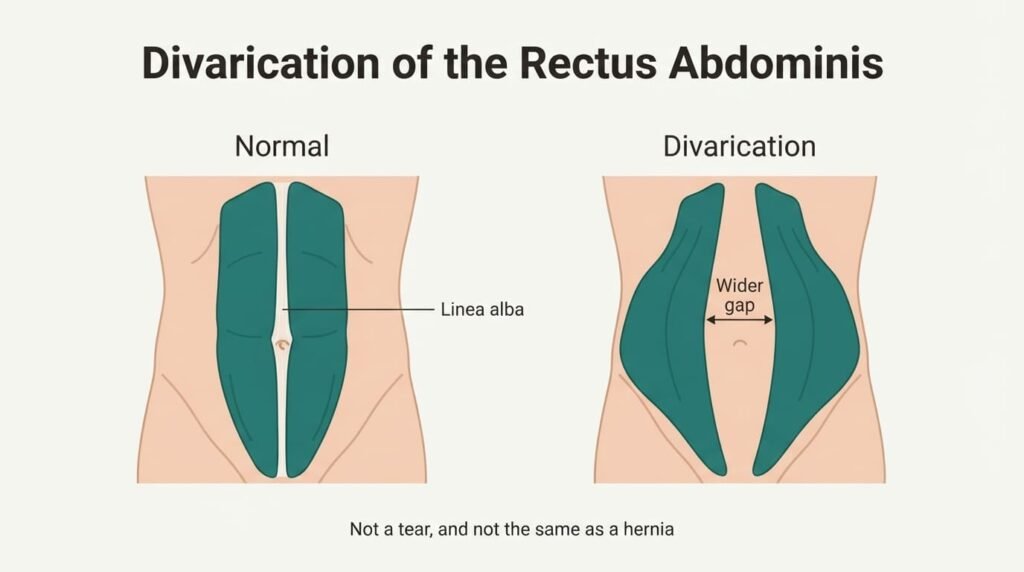
Your rectus abdominis is the long muscle that runs down the front of your stomach. It has a left and a right side, joined down the middle by a band of connective tissue called the linea alba. When that band stretches and widens, the two sides sit further apart.
It is not a tear in the muscle, and it is not the same thing as a hernia, although the two can occur together. The most common sign is a soft ridge or dome that appears down the middle of your stomach when you sit up from lying down.
| You may hear it called | What it means |
|---|---|
| Diastasis recti | The most common name |
| Divarication of the recti | The term often used in the UK and by surgeons |
| Rectus diastasis | Another medical name |
| Abdominal separation | The everyday description |
| Mummy tummy | A popular name that is not very accurate, as men get it too |
What causes it?
The main cause is pressure on the abdominal wall stretching the connective tissue over time. Pregnancy is by far the most common reason, because the growing uterus stretches the abdomen. Other possible factors include carrying extra weight around your middle and, perhaps, repeated heavy lifting or straining.
In a study of 300 first-time mothers, risk factors did not differ much between those with and without diastasis, apart from a greater likelihood among women who reported heavy lifting 20 or more times a week.
How common is it, and does it cause problems?
That same study followed women through pregnancy and after giving birth.
| Time point | Women with diastasis |
|---|---|
| 21 weeks pregnant | 33 percent |
| 6 weeks after birth | 60 percent |
| 6 months after birth | 45 percent |
| 12 months after birth | 33 percent |
So it is very common and it often improves over time, although not for everyone. There is also some reassuring news. In that study, women with and without diastasis reported the same amount of lower back and pelvic pain at 12 months. Having a gap does not automatically mean you will have pain.
How to check for diastasis recti at home
This self-check gives you a rough idea. It is not a diagnosis.
- Lie on your back with your knees bent and feet flat on the floor
- Place your fingertips across the midline of your stomach, just above your belly button, with your fingers pointing toward your toes
- Relax, then gently lift your head and shoulders off the floor, as if starting a small crunch
- Feel how many finger widths fit into the gap between the two sides of the muscle
- Also notice how deep your fingers sink, and whether the area feels firm or soft
- Repeat at the belly button and just below it
| What you may find | What it might suggest |
|---|---|
| Gap of less than about 2 finger widths and firm tissue | Often considered within a normal range |
| Gap of 2 or more finger widths | Possible diastasis, worth having checked |
| Fingers sink deeply and tissue feels soft | Connective tissue tension is low, so get it assessed |
| Dome or ridge when you sit up | A common visual sign |
| A painful lump, or one that does not go back in | Could be a hernia, so see a doctor |
A physiotherapist can measure the gap more accurately, sometimes with ultrasound. Finger measurements are rough, so do not worry too much about small differences.
What the research says
I think this is the most important part of this guide, because many programmes online make claims that go far beyond the evidence.
| Study | What it found | What it means for you |
|---|---|---|
| Systematic review of 8 studies (2014) | Exercise during pregnancy reduced the presence of diastasis by 35 percent, but the studies were of poor quality. The authors concluded that exercise may or may not help | Promising, but far from proven |
| Trial of a postpartum exercise programme (2018) | A weekly supervised programme of pelvic floor and abdominal training did not reduce how many women had diastasis at 6 or 12 months | A general exercise class may not close the gap |
| Ultrasound study of 38 women (2020) | During a head lift and a twisted curl-up, the gap narrowed. During maximal drawing-in, it widened below the belly button | Curl-ups are not automatically harmful, but this shows only the effect during the exercise, not long-term change |
So the honest summary is this. Nobody has yet proven which divarication of rectus abdominis muscles exercises work best, or that exercise closes the gap permanently. Exercise is still worthwhile, because it builds strength, helps you feel more confident and improves how you function day to day. And the old advice to avoid every curl-up is less certain than it once seemed.
Rules for diastasis recti exercises
- Get checked first if you can. Before you start divarication of rectus abdominis muscles exercises, a pelvic health physiotherapist can tailor a plan for you
- Wait for clearance after birth. Follow your midwife’s or doctor’s advice before starting exercise
- Watch your stomach as you move. If a dome or ridge pops up down the middle, make the exercise easier
- Keep breathing. Breathe out on the effort, and avoid holding your breath and straining
- Build up slowly. Add difficulty only when the easier version feels controlled
- Stop if you feel pain, or a bulge, or if you leak urine. These are reasons to get advice
8 divarication of rectus abdominis muscles exercises
These are gentle exercises commonly used in rehabilitation. They are listed from easiest to hardest. Remember that the evidence for any one exercise is limited, so use them as a sensible starting point, not a guaranteed fix.
1. Deep belly breathing with a gentle exhale
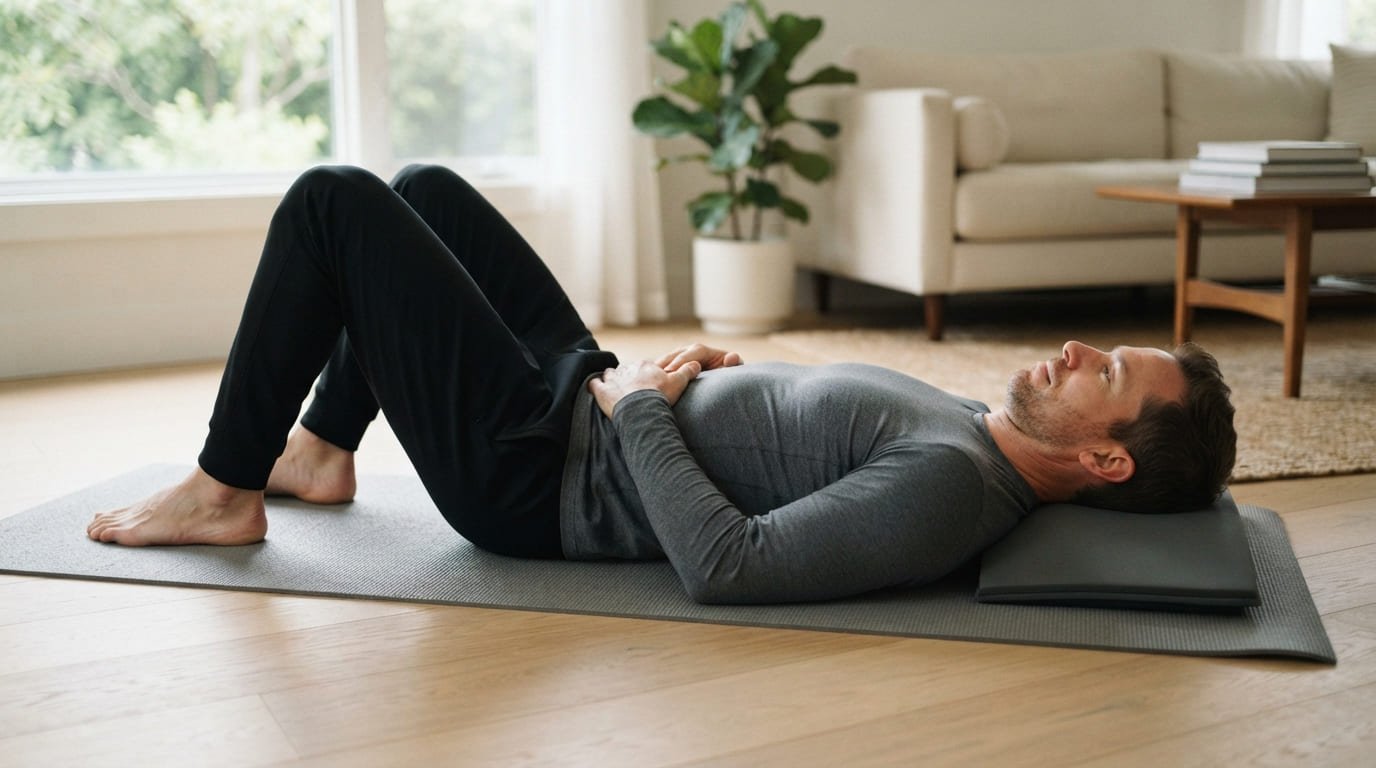
Lie on your back, knees bent, with your hands on your lower ribs. Breathe in through your nose and let your ribs and belly widen. Breathe out slowly through your mouth and feel your lower stomach gently tighten. Do 10 slow breaths. It teaches you to coordinate your breathing with your core.
2. Pelvic tilts
Lying in the same position, breathe out and gently flatten your lower back into the floor by tilting your pelvis. Breathe in and return. Do 10 to 15 slow reps. Our guide to anterior pelvic tilt exercises explains this movement.
3. Gentle abdominal brace
Breathe out and lightly tighten all the way around your waist, without sucking in hard or pushing out. Hold for 5 to 10 seconds while breathing normally. Do 8 to 10 reps. Use about a quarter of your effort. Our guide to abdominal bracing exercises has more detail. Note that in the ultrasound study, maximal drawing-in widened the gap below the belly button, so keep this gentle rather than pulling in as hard as you can.
4. Heel slides
Lying on your back, gently brace and slowly slide one heel along the floor until your leg is straight, then slide it back. Keep your pelvis still. Do 8 to 10 per leg. Watch for doming, and make the slide shorter if you see any.
5. Glute bridge
Breathe out and lift your hips until your body forms a straight line from shoulders to knees, then lower slowly. Do 2 to 3 sets of 10 to 12. Strong glutes support the whole trunk. Our guide to the glute bridges exercise covers form and variations.
6. Head lift
Lie on your back with your knees bent. Breathe out and gently lift just your head and the tops of your shoulders off the floor, then lower slowly. Do 2 sets of 8 to 10. In the ultrasound study, this movement narrowed the gap while it was being done. Watch for doming, and go back to easier moves if you see it. If your physiotherapist has told you to avoid this, follow their advice.
7. Side plank from the knees
Lie on your side, propped on your forearm, knees bent. Lift your hips until your body forms a straight line from shoulders to knees. Hold for 10 to 20 seconds per side. It trains the muscles on the sides of your waist, without loading the midline as much as a front plank.
8. Bird dog
On all fours, gently tighten your stomach and reach one arm forward and the opposite leg back. Hold for 5 seconds, return and switch. Do 2 sets of 6 per side. Move on to this when you can stay on all fours with no sagging or doming. Our beginner core workout shows you how to do it.
A 6-week plan
This plan puts the divarication of rectus abdominis muscles exercises above into a simple order. Do it 3 or 4 times a week. If any week feels too hard, repeat it. If you are recently postpartum, check with your midwife or physiotherapist first.
| Week | Exercises | Sets and reps |
|---|---|---|
| 1 | Belly breathing, pelvic tilts | 10 breaths, 2 x 10 |
| 2 | Belly breathing, gentle brace, heel slides | 10 breaths, 2 x 8, 2 x 8 per leg |
| 3 | Gentle brace, heel slides, glute bridge | 2 x 10, 2 x 10 per leg, 2 x 10 |
| 4 | Glute bridge, head lift, side plank from the knees | 3 x 10, 2 x 8, 2 x 15 seconds per side |
| 5 | Glute bridge, head lift, bird dog, side plank | 3 x 12, 2 x 10, 2 x 6 per side, 2 x 20 seconds per side |
| 6 | All of the above, plus sit-to-stands or light squats | 2 x 10 of each |
After this, a physiotherapist can help you move toward everyday strength exercises such as squats, rows and carries, and then full training. Walking is great throughout.
Exercises to be careful with
Doing divarication of rectus abdominis muscles exercises does not mean you have to avoid everything else. Older advice told people to avoid all curl-ups and twists forever. The current picture is less strict, but while you are rebuilding your strength, it makes sense to be careful with moves that cause doming, pain or straining.
| Be careful with | Why | Try instead |
|---|---|---|
| Full sit-ups and crunches with doming | Pressure can push the stomach outward | Head lifts with no doming |
| Full front planks and push-ups, early on | High load on the midline | Side plank from the knees, wall push-ups |
| Double leg lifts | Very hard for the abdominal wall | Heel slides |
| Heavy lifting with held breath | Raises the pressure inside your abdomen | Lighter loads, and breathe out as you lift |
| Getting out of bed straight forward | Causes doming | Roll to your side first, then push up with your arms |
Being careful does not mean these moves are off limits for life. Many people return to them over time, once they can do them without doming, pain or leaking.
Everyday habits that help
- Roll to your side when you get out of bed, instead of sitting straight up
- Breathe out when you lift a child, shopping or anything heavy
- Keep things close to your body when you carry them
- Avoid constipation and straining. Fibre, fluids and activity help
- Keep moving. Alongside your divarication of rectus abdominis muscles exercises, walking is one of the best things you can do. Our guide to walking has a simple plan
Diastasis recti exercises for men
Men can have diastasis too. It often shows up as a ridge or a bulge above the belly button, and is often linked to carrying extra weight around the middle. It has been studied far less than the postpartum version, so I cannot point to good trials of diastasis recti exercises for men in particular.
| Point | What I would suggest for men |
|---|---|
| Getting checked | See a doctor to rule out a hernia, especially if there is a bulge that hurts or does not go back in |
| Exercises | The same divarication of rectus abdominis muscles exercises apply. Start with breathing, bridges and side planks |
| Lifting | Reduce heavy lifting that causes doming, and avoid straining while holding your breath |
| Body weight | If you carry extra weight around your middle, gradual fat loss may help reduce pressure. See our guide to the best exercises for belly fat loss |
| Gym work | Return gradually to squats, deadlifts and sit-ups, watching for doming |
Many men have a mild gap and never know it. If it does not cause pain or problems, it may not need any treatment. But do get it looked at if it is growing or bothering you.
After pregnancy
If you have recently had a baby, some separation is completely normal and often improves in the first few months. Here is what I would suggest:
- Ask your midwife, doctor or a pelvic health physiotherapist to check your stomach and your pelvic floor
- Start with gentle breathing and walking when you feel ready and have been cleared. Each exercise for diastasis rectus abdominis in this guide can then be added slowly
- Train your pelvic floor as well. Our guide to pelvic floor exercises explains how
- Do not rush back to running, jumping or heavy lifting
- Be kind to yourself, and do not treat divarication of rectus abdominis muscles exercises as a race. Your body has done something remarkable, and recovery takes time
Studies show that many women still have some separation a year later, and that this is common. It does not mean you have failed at your exercises.
When to see a doctor or physiotherapist
Get professional advice if you have:
- A bulge that hurts, feels firm, or does not go back in when you lie down
- Severe or sudden pain in your stomach. Seek urgent help if a bulge becomes painful and you also feel sick or vomit
- Ongoing back or pelvic pain
- Urine leakage or a feeling of heaviness in the pelvis
- A gap that is not improving after several months of steady exercise, or that really bothers you
Some people with large gaps and ongoing symptoms discuss surgery with a specialist, usually after they have tried a rehabilitation programme and finished having children.
This article is general information, not medical advice. Please see a doctor or a pelvic health physiotherapist for diagnosis and a plan tailored to you. See our medical disclaimer.
Common mistakes
| Mistake | Why it matters | Fix |
|---|---|---|
| Chasing a smaller gap only | Function matters too | Focus on strength, comfort and control |
| Avoiding all exercise | Weakness can make things worse | Start gently and stay active |
| Doing hard ab moves straight away | Can cause doming and strain | Build up through the plan |
| Sucking in as hard as you can | In one study it widened the gap below the belly button | Use a gentle, all-round brace |
| Buying expensive programmes that promise to close the gap | The evidence does not support big promises | Spend the money on a physiotherapy assessment instead |
| Assuming every bulge is diastasis | It could be a hernia | Get it checked |
The bottom line
Divarication of the rectus abdominis is common, especially after pregnancy, and it is usually not dangerous. The research on exercise is limited: some studies are hopeful, one good trial found no effect on how many women had it, and no exercise has been proven to close the gap for good. So divarication of rectus abdominis muscles exercises are best seen as a way to rebuild strength and function, not as a guaranteed fix.
Start with gentle breathing, pelvic tilts, heel slides and bridges, watch for doming, and build up slowly over six weeks. Get a proper assessment from a pelvic health physiotherapist or doctor if you can, and always get a painful bulge checked. With patience, most people can get back to the activities they love.
Frequently asked questions
What are the best divarication of rectus abdominis muscles exercises?
Gentle options include deep belly breathing, pelvic tilts, a light abdominal brace, heel slides, glute bridges and side planks from the knees. Evidence for any single exercise is limited, so ask a physiotherapist to tailor a plan for you.
How often should I do divarication of rectus abdominis muscles exercises?
Three or four short sessions a week is a sensible starting point, and gentle breathing can be done daily. Add harder moves only when you can do them without doming, pain or leaking.
What is the safest exercise for diastasis rectus abdominis?
Gentle belly breathing, pelvic tilts and heel slides are usually the easiest places to start, because they load the midline very little. A physiotherapist can tell you what suits you.
Can diastasis recti be fixed with exercise?
Exercise can improve strength and function, and the gap often narrows with time. However, no exercise has been proven to close it permanently, and one trial of a postpartum programme did not reduce how many women had diastasis.
Are crunches bad for diastasis recti?
Not automatically. An ultrasound study found that head lifts and curl-ups narrowed the gap during the exercise. Still, stop or make the move easier if you see doming or feel pain, and follow your physiotherapist’s advice.
How do I know if I have diastasis recti?
Lie on your back, put your fingers across your midline and lift your head slightly. A gap of about 2 finger widths or more, or a dome down the middle, can suggest diastasis. A physiotherapist or doctor can confirm it.
Can men get diastasis recti?
Yes. It is often linked to extra weight around the middle and possibly to heavy lifting. It has been studied far less in men, so get it checked if it is growing or painful, and start with gentle core exercises.
How long does diastasis recti take to heal?
It varies. In one study, about 60 percent of women had it at 6 weeks after birth, falling to about 33 percent at 12 months. Some people improve within months, and others keep a gap for longer.
Is diastasis recti the same as a hernia?
No. Diastasis is a widening between the muscles, while a hernia is when tissue pushes through a weak spot. They can occur together, so see a doctor about any lump that hurts or does not go back in.
Does diastasis recti cause back pain?
Not necessarily. In one study, women with and without diastasis reported the same amount of lower back and pelvic pain at 12 months after birth. If you have ongoing pain, a physiotherapist can look for the cause.
When can I start exercises after giving birth?
Follow your midwife’s or doctor’s advice. Gentle breathing, pelvic floor exercises and short walks often start early, while harder exercise usually waits until you have been checked, and until you feel ready.
What’s next?
Reading is the easy part. Pick one of these and do it today.